Thursday, December 21, 2017

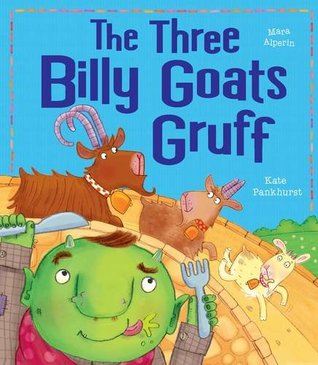
The Three Billy Goats Gruff by Mara Alperin

21294622
The Three Billy Goats Gruff
By: Mara Alperin
Illustrated By: Kate Pankhurst
Lexile Level: AD 540L
Genre: Fiction, Folklore
Bibliographic Information: Alperin, M. (2014). The Three Billy Goats Gruff. New York, NY: Scholastic Inc.

Summary: Three billy goat brothers reach a bridge to a meadow. A slobbering, old troll blocks their path. How do you trick a troll who wants to eat you?

Selling Tool: Here is my infographic for this book.

Possible Learning Activity: Students will brainstorm different ways the goats can get to the meadow without being eaten by the troll.

Standards:
New York State Common Core:
CCSS.ELA.Literacy.RL.3.2. - Recount stories, including fables, folktales, and myths from diverse cultures; determine the central message, lesson, or moral and explain how it is conveyed through key details in the text.
CCSS.ELA.Literacy.RL.3.5-Refer to parts of stories, dramas, and poems when writing or speaking about a text, using terms such as chapter, scene, and stanza; describe how each successive part builds on earlier sections.

Learning Objectives:
  1. Students will work in small groups to brainstorm different ways the goats can get across the bridge without being eaten by the troll.
  2. Students will thinking critically and use problem solving skills to brainstorm ideas.
  3. Students will share their small group ideas with the class as a whole.

Possible Learning Outcome: Students will learn how to work in a small group, or team, in order to find a solution to a problem. Students will practice critical thinking and problem solving skills.

The Boy in the Striped Pajamas by John Boyne

This book was used in my Standards Aligned Literature Grouping which can be found in its entirety in another blog post.

Fiction Book
Boyne, John. The Boy in the Striped Pajamas. David Fickling Books, 2006.
Lexile: 1000L
Grades: 6-8
Topics/Tags: Historical fiction, Holocaust, Concentration camps, World War II
Summary: Bruno, a nine-year old German boy, moves to a new house after his father has received a promotion. The house is far away and there is no one for Bruno to play with. There is a tall fence running alongside the house as far as the eye can see. While exploring one day, Bruno meets a boy on the other side of the fence - a boy in striped pajamas. This boy’s life is very different from Bruno’s and their friendship has devastating consequences.


Alignment:
Learning Standards:
  • Grades 5-8 Common Core Reading Standards for Literacy in History/Social Studies (NYS)
    • Key Ideas and Details
  1. Cite specific textual evidence to support analysis of primary and secondary sources.
  • Integration of Knowledge and Ideas
7.    Integrate visual information (e.g., in charts, graphs, photographs, videos, or maps) with other information in print and digital texts.
  • Common Core English Language Arts Standards Grades 6-12
    • Responding to Literature
11.   Respond to literature by employing knowledge of literary language, textual features, and forms to read and comprehend, reflect upon, and interpret literary texts from a variety of genres and a wide spectrum of American and world cultures.
  • AASL Standards For The 21st-Century Learner
    • 1.1.6 Read, view, and listen for information presented in any format (e.g., textual, visual, media, digital) in order to make inferences and gather meaning.
    • 1.1.7 Make sense of information gathered from diverse sources by identifying misconceptions, main and supporting ideas, conflicting information, an point of view or bias.


Learning Goals:
  • Learners will be introduced to life for children during the Holocaust.
  • Learners will read, view, and listen for information gathered from fiction and nonfiction texts, including primary sources.
  • Learners will make sense of information gathered to create a diary entry.


Learning Objectives:
  1. Cognitive
    • Students will assess and analyze documents (both primary/secondary and fiction/nonfiction).
    • Students will understand the living conditions of children during the Holocaust.
  2. Affective
    • Using primary source documents, such as diary entries, students will be able to describe and understand the living conditions of children during the Holocaust.
    • Photographs and primary source documents will help teach students the horrors of the Holocaust for children around their age. Students will react to these sources during class and small group discussions.
  3. Psychomotor
    • Students will write a diary entry from the point of view of a child living during the Holocaust using information gathered from nonfiction and fiction texts.


Learning Outcomes:
Learners will be able to:
  • Articulate specific details about life during the Holocaust for children.
  • Gather and use information from fiction and nonfiction text to write a diary entry from the point of view of a child living during the Holocaust.


Activity:
What will children be doing? What activities will they engage in to meet the Standards, Goals, Objectives, and Outcomes?

  • Multi-day activities. Students will first read fiction text.
  • After reading text, they will manipulate the nonfiction text to find supporting factual information for the fiction text - which historical details of the fiction text are true/false.
  • The students will complete station work on the Holocaust - mimicking the Holocaust Memorial Museum. They will receive a passport of a child around their age (12-15) and follow their child’s passport around the stations, answering questions about the child (ghettos, concentration camps, liberation, resistance). The stations and passports will relate back to the texts, both fiction and nonfiction.
  • Students will write their own journal entries from the point of view of a child in Europe during the Holocaust.
    • This can be from the point of view of a child living in a ghetto, concentration camp, in hiding, or a part of a resistance movement.
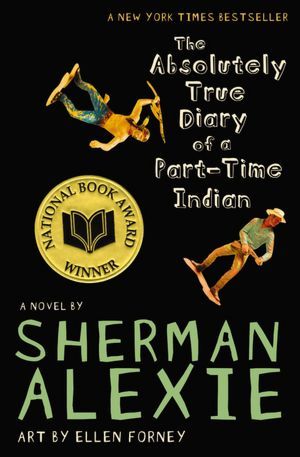
The Absolutely True Diary of a Part-Time Indian by Sherman Alexie

The Absolutely True Diary of a Part-Time Indian
By: Sherman Alexie
Image result for the absolutely true diary of a part-time indian
Lexile Level: 600L
Suggested Grades: 9-12
Genre: Realistic Fiction
2007 National Book Award Winner

Summary: Junior is a 14-year-old living on the Spokane Indian reservation. Trying to better his life, he starts attending a nearby all-white high school. His own people look at him like he’s a traitor and the kids in his new school look at him like he’s an outsider. He struggles to make friends and adjust to his new environment. This novel is based on the author’s own experiences. It features drawings by Ellen Forney that reflect the character’s art. It tells a story of one young Native American trying to break away from the life he was destined to live.

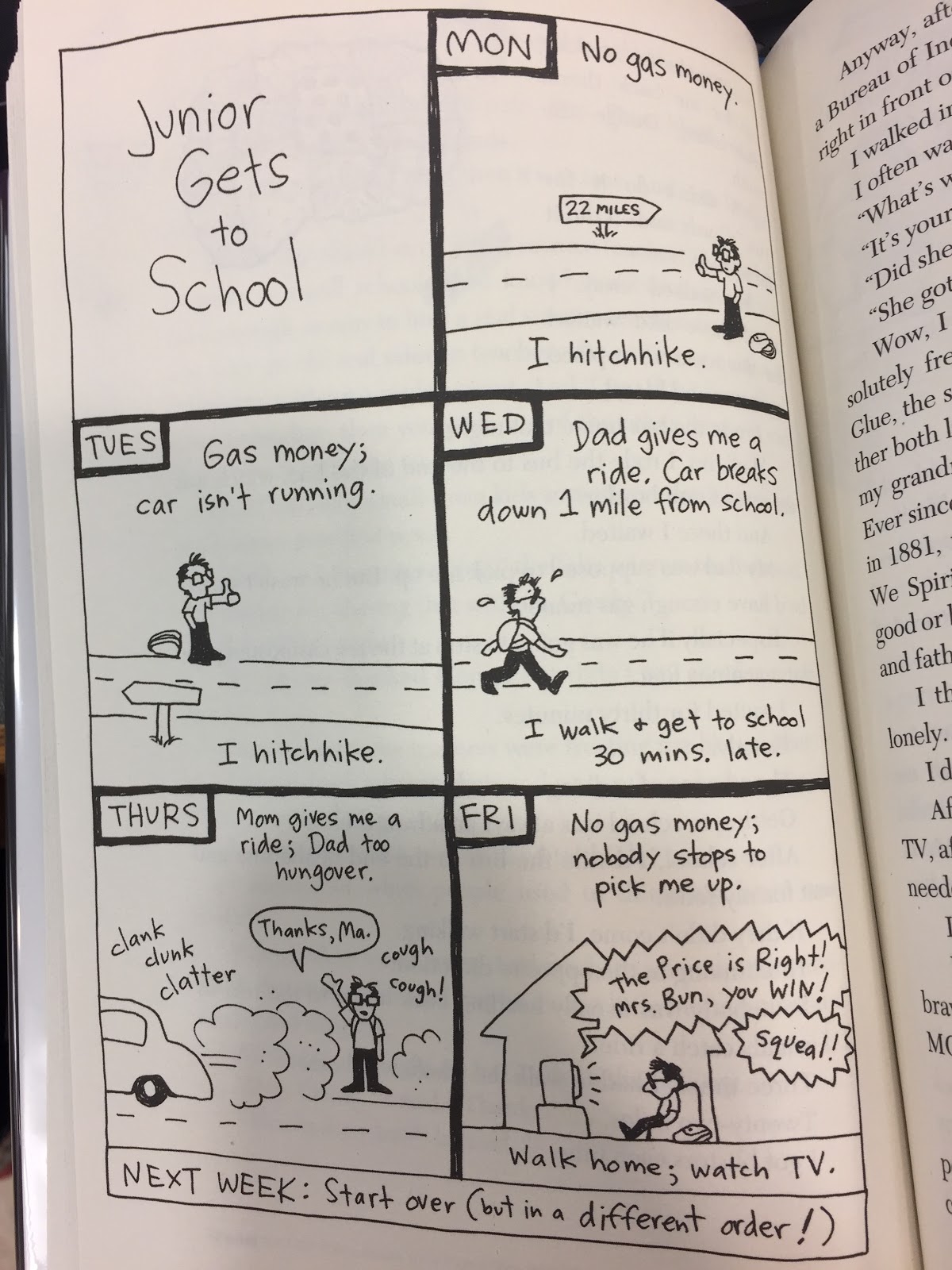
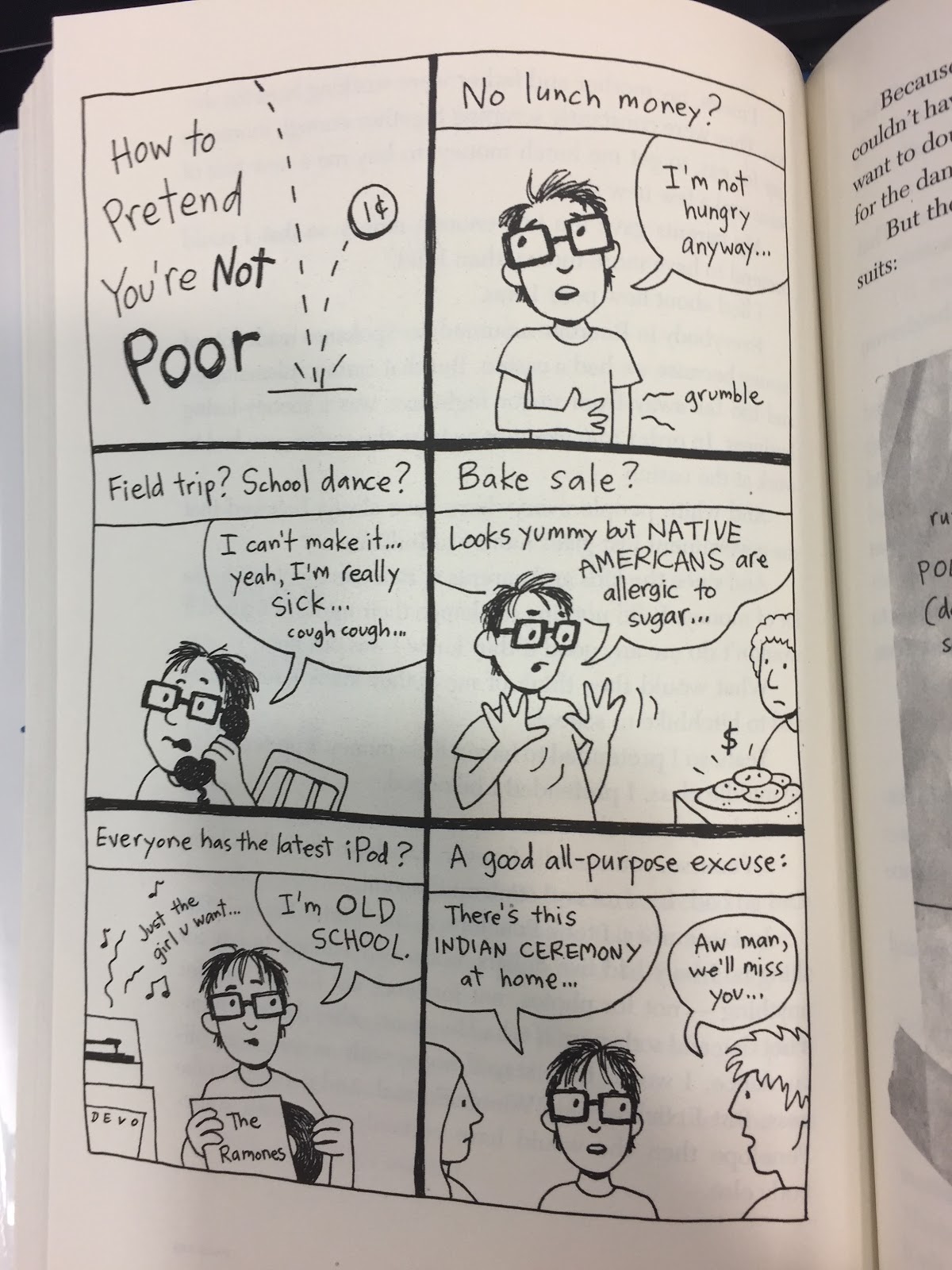
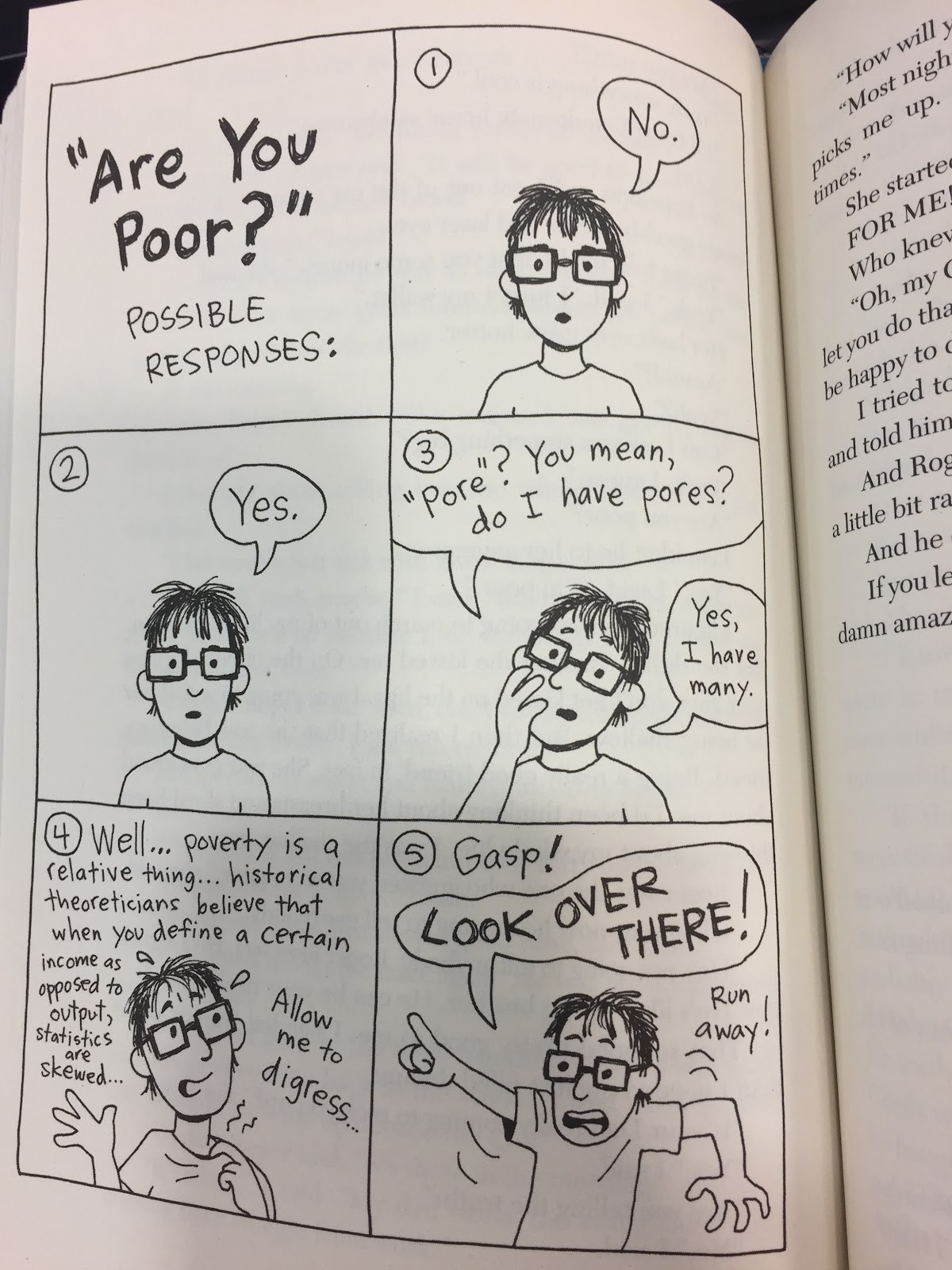
Possible Learning Activity: Throughout the novel, Junior talks about how he draws pictures and comics. Ellen Forney created illustrations to supplement the writing of Sherman Alexie. Students will write a mini biography about themselves and include a narrative comic. There are several examples from the text that students can use. Here are a few examples:
image1.jpegimage2.jpegimage3.jpeg


Standards:
New York State Learning Standards and Core Curriculum:
CC.RL.9-10.2. Determine a theme or central idea of a text and analyze in detail its development over the course of the text, including how it emerges and is shaped and refined by specific details; provide an objective summary of the text.
CC.RL.9-10.3 Analyze how complex characters (e.g., those with multiple or conflicting motivations) develop over the course of a text, interact with other characters, and advance the plot or develop the theme.

Learning Objectives:
  1. Students will draw parallels between themselves and the characters of the novel, develop an understanding of the internal and external expectations of their lives and will write a journal entry on how their lives relate to one of the characters from the novel.
  2. Students will explore the roles that other people play in their lives to develop an understanding of how societal and familial expectations shape their choices and work in groups to write down the different ways family and society affects their choices..
  3. Students will create a comic strip portraying an event in their lives. They will use examples from the text to creatively portray the event.

Possible Learning Outcome: Students will make connections to the characters of the novel and recognize that there are external and internal forces that shape their daily decisions. They will also create a mini comic strip that portrays an event in their lives.

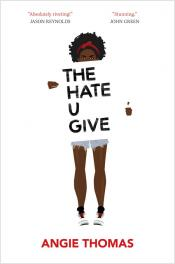
The Hate U Give by Angie Thomas

The Hate U Give
By: Angie Thomas
Lexile Level: HL590L
Suggested Grades: 7-12
Genre: Fiction
Topics: Racism, Protests, Racially Motivated Violence, Urban Areas

Thomas, A. (2017). The hate u give. New York, NY: Balzer + Bray.

Summary:
Starr Carter is a sixteen-year-old high school student caught between two worlds: the poor neighborhood she lives in and the suburban prep school she goes to. The balance she has been keeping between the two is broken when she witnesses the shooting of her childhood best friend at the hands of a police officer. Khalil was unarmed. His death becomes a national headline and Starr is the only witness. Everyone wants to know one thing: what really happened that night. She must decide what to do or not do. This decision could change her entire community and will bring her two worlds crashing together.

Click here for an infographic.

Standards:
New York State Learning Standards and Core Curriculum:
CC.RL.9-10.2. Determine a theme or central idea of a text and analyze in detail its development over the course of the text, including how it emerges and is shaped and refined by specific details; provide an objective summary of the text.
CC.RL.9-10.3 Analyze how complex characters (e.g., those with multiple or conflicting motivations) develop over the course of a text, interact with other characters, and advance the plot or develop the theme.

Possible Learning Activity:
Students will listen to the NPR interview by author Angie Thomas (transcript provided). Students will also view the video of Tupac Shakur explaining the acronym Thug Life (where the title of the book comes from). Students will also read “Death by Police” by Adrienne Lafrance and view the TED Talk “How to Raise a Black Son in America” by Clint Smith (transcript provided that can be translated into multiple languages). Students will use these resources to answer the following essential questions.

Essential Questions:
  1. Should every African American family give their children “the talk” of how to survive a police encounter?
  2. What should be done to help neighborhoods that are plagued with violence and gang activity?
  3. What supports are available to teenagers who want to be activists?

Objectives:

  1. Students will read, listen to, and view supporting clips to answer the essential questions.
  2. Students will write short answers to the essential questions and discuss answers in small groups and with the whole class.

Wonder by R.J. Palacio

As I start to write this, I literally just finished Wonder. I haven't fully decompressed from it. My first initial thought: Wow. My second: Why am I just reading this now? I don't think I'm alone in loving this book. I laughed. I cried. I got angry. I cried again. I laughed some more. This book is one that will stay with me for a while. The only complaint I have about it is in Justin's part; the complete lack of punctuation messed with me. I really love the message of kindness throughout the book. It is such a powerful theme and really resonates throughout the story. I also like how the narrator bounces between characters. It allows the reader to really get to know the character during their point of view chapters.
Considering the standards, this piece can be used in several ways. You can have students work with information text on the causes and effects of Treacher Collins Syndrome (the genetic condition that affects Auggie). Amy Tan's short story "Fish Cheeks" about a young girl who is embarrassed by her family can help students better understand Via's characters. Students could also look at informational text and research herd behavior; the psychological behaviors of how people act in groups. Students could also pair this with other fiction books that deal with bullying or make connections with their own experiences.

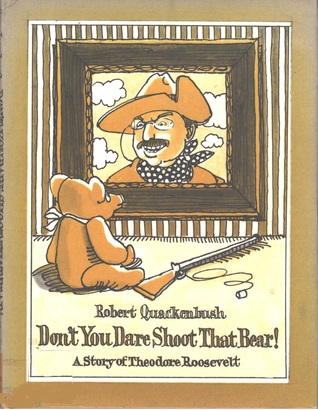
Don't You Dare Shoot That Bear: A Story of Theodore Roosevelt by Robert Quackenbush

Don’t You Dare Shoot That Bear!: A Story of Theodore Roosevelt
By: Robert M. Quackenbush
1293227
Genre: Biography, Nonfiction
Grade: 4-8

Summary: The life and times of the 26th President of the United States, Theodore Roosevelt. This work discusses government, foreign policy, the environment, industrial working conditions, and food production standards. This is a very informative read about the impact Teddy Roosevelt had on the United States.

Possible Learning Activity: Students will use the text to create a presidential timeline

Learning Objectives:
  1. Students will understand sequence of events and chronological order.
  2. Students will understand the events of the Roosevelt administration.
  3. Students will use text to create a timeline of events during Theodore Roosevelt’s years as President of the United States.

Possible Learning Outcome: Students will develop chronological thinking skills to create a timeline of events. Timelines are very helpful for teaching history.

Book Talk - The Voice of the People: American Democracy in Action

Bibliographic Information: Maestro, B. & Maestro, G. (1996). The voice of the people: American democracy in action. New York, NY: Lothrop, Lee, & Shepard Books.
Intended Audience: Grades 4-8
Approach: I think my approach would be considered mood-based.
The Talk: In the early hours of the morning, people line up at firehouses, public buildings, and schools all across America. It's Election Day. By voting, American citizens exercise their right to participate in government. But, how does all that work? The Maestro's have hit a home run again with their book The Voice of the People: American Democracy in Action. This books tells you everything you need to know about how democracy in the United States works. There are colorful pictures that show off some of the prominent people and buildings of our government. With Election Day quickly approaching, you are definitely going to want to check this book out!
Here is the link to my video. Please bear with me. I have been very sick for the past week. Don't mind my appearance or my voice.

The Story of the Statue of Liberty by Betsy & Giulio Maestro

The Story of the Statue of Liberty
By: Betsy & Giulio Maestro
The Story of the Statue of Liberty
Lexile Level: AD740L
Suggested Grades: 3-5
Genre: Non-Fiction

Summary: This is a comprehensive history of one of America’s beloved landmarks. Since erected in New York Harbor in 1886, the Statue of Liberty has welcomed millions of immigrants to the United States. She is a symbol of hope and freedom. However, many do not know that the story really begun 15 years earlier, when the French sculptor Frédéric Bartholdi made plans for the statue to present to the American people as a gift from France.

Click here for a selling tool, a book review, on this book.

Suggested Learning Activity: Students will compare the colossal size of the Statue of Liberty to their own bodies. After reading The Story of the Statue of Liberty, students will measure their own bodies and use the Statue Statistics on the National Park Service website on the Statue of Liberty to compare their size to the statue’s size.

Standards:
AASL: 1.1.1 Follow and inquiry-based process in seeking knowledge in curricular subjects and make the real world connections for using this process in own life.
1.1.7 Make sense of information from diverse sources by identifying misconceptions, main and supporting ideas, conflicting information, and point of view of bias.

Common Core Standards: CC.8.R.I.1 Key Ideas and Details: Cite the textual evidence that most strongly supports an analysis of what the text says explicitly as well as inferences drawn from the text.
CC.7.R.I.2 Key Ideas and Details: Determine two or more central ideas in a text and analyze their developments over the course of the text; provide an objective summary of the text.

Objectives:
  1. Students will generate a list of the different parts of the Statue of Liberty (i.e. nose, eyes, fingers, feet, head, arm, etc.)
  2. Students will measure their own body parts and convert their measurements from inches to feet.
  3. Students will hypothesize how big they think the various parts of the statue are. They will hypothesize how many students make up each part. For example, how many students might equal the length of the statue’s foot.
  4. Students will compare the sizes of their own bodies to that of the Statue of Liberty.
  5. Students will calculate if the various body parts will fit in their classroom.

Potential Learning Outcome: Students will compare the size of the Statue of Liberty to their own bodies to realize the colossal size of the statue.