Showing posts with label Sensitive. Show all posts

Thursday, December 14, 2017

Standards Aligned

Sam Romano
IST 571
Standards Aligned Literature Grouping with Rationale

https://lh5.googleusercontent.com/Hx9aomlRk_YrWiA8b_tX5sFG8IJSF2_8NzcOb7zFdaAHcqWE6hZSCDdN0-TLQcKPzNP6bJKO6LLMSGS2dsfxttREUZgEkNC2n-_VWG1euBpCkSVoTtTJD9Di6-JROKYv1XYPcSup


Fiction Book
Title: Fireboat: The Heroic Adventures of John J. Harvey
Author/Illustrator: Maria Kalman
Lexile Level: AD600L

Alignment
For this learning activity, students will be tasked to draw their version of what a ‘hero’ is. After the class has completed their drawings, students will present their images to the class and explain why they chose their hero.
Standards:
CCSS.ELA-LITERACY.SL.2.4 Tell a story or recount an experience with appropriate facts and relevant, descriptive details, speaking audibly in coherent sentences.
CCSS.ELA-LITERACY.SL.2.6 Produce complete sentences when appropriate to task and situation in order to provide requested detail or clarification.
Goal: Students will be able to understand that acts of heroism can come from those not typically written about or seen in literature or films.
Objective:
(Psychomotor)Students will be able to draw an image of what they consider to be a hero.
(Cognitive) Students will be able to relate their reasoning for choosing their hero audibly to the rest of the class.
(Affective) Students will recognize and identify values that they admire in heroic figures.
Outcome: Students will gain a deeper appreciation for the historical significance of those who stepped in to help during a national tragedy.

 
Saved by the Boats
Gassman, Julie. Saved by the Boats. Capstone Young Readers, 2016.
Lexile Level: 415L to 635L
This text works as a great supplement to Fireboat, and it can help strengthen students’ understandings of the rescue efforts on an incredibly tragic and culturally impactful day in history.

 
Chief: The Life of Peter J. Ganci, a New York City Firefighter
Ganci, Chris. Chief: the life of Peter J. Ganci, a New York City firefighter. Orchard Books, 2003.
Lexile Level: 890L
Just as students learned about the fireboat used to help calm the fires after 9/11, this tale can be used for anecdotal research on what happened on land during that same day and about the brave men who lost their lives.

America Is Under Attack: September 11, 2001: The Day the Towers Fell
Brown, Don. America is under attack: September 11, 2001: the day the towers fell. Square Fish/Roaring Brook Press, 2014.
Lexile Level: 840L
This text will help students learn more about September 11th and the cultural, societal, and emotional impact it has left on our country.


Understanding September 11th: Answering Questions about the Attacks on America
Frank, M. (2002). Understanding September 11th: answering questions about the attacks on America. New York: Viking.
Lexile Level: 415L to 855L
For younger readers, this book can help contextualize some of the tougher questions surrounding the 9/11 terrorist attack, and can give perspective for students who might be too young to remember.

References:

“LESSON E-UIV-L1 A Fireboat and Its Heroic Adventures .” For Action Initiative, 2012, www.foractioninitiative.org/img/pages/54/lesson/Lesson-E-UIV-L1.pdf.

Tuesday, December 12, 2017

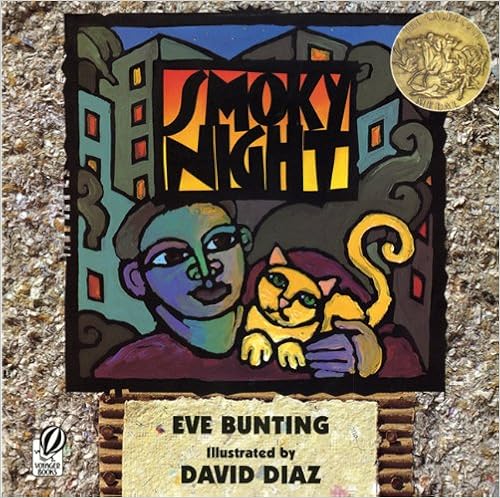
Smoky Night by Eve Bunting


Bunting, Eve. Smoky Night. Turtleback Books, 1999.
Lexile Level: 530L


Book Review

Smoky Night by Eve Bunting is a beautifully written and illustrated book that tackles a very difficult and sensitive issue in a sensitive and compelling way. Set during the Los Angeles riots in 1992, Bunting's book tells the story of a young boy named Daniel who witnesses the racially charged rioting that occurred as a result of increasing unrest that was finally unleashed following the announcements of the verdicts in the Rodney King trial. Daniel goes to bed assuming that the riots had ended peacefully, only to be awoken in the middle of the night to find that his apartment building his been lit ablaze during the chaos. Daniel does not want to leave, however, as he is unable to locate his cat, thus the search for Daniel's cat in the middle of the riots becomes the core story of the book. Bunting does a wonderful job of demonstrating the severity of the riots as a whole, but also of giving the reader a window into how the riots impacted those involved on an individual level. Smoky Night is an excellent way to introduce a sensitive, difficult topic like the Los Angeles riots to children, allowing them to learn how serious and chaotic they were, without weighing them down with the heavy, graphic details of the event.
Learning Activity
The setting of this story is rooted in racial differences and inequalities. Daniel asks several questions to his mother about the riots and about how he should interact with others of his race versus those of another. I want to focus this activity on exploring the students interact with others that are different in a myriad number of different ways, yet are still friends and colleagues with those they are different from. After reading Smoky Night, I would have the students pair up and ask each other a handful of questions about their partner. Questions could include, but are not limited to, where is your family from?, how do you celebrate certain holidays?, etc..., in an effort to learn about their colleagues. They would then present their findings to the rest of the class.
Learning Standards
CCSS.ELA-LITERACY.RL.3.6
Distinguish their own point of view from that of the narrator or those of the characters.
Goal
The goal of this exercise is to help the students see that, although their friends and colleagues may have different backgrounds, beliefs, and ideals, they are all worthy of acceptance and inclusion.
Objective

Students will ask a partner questions about their background and home life, in an effort to learn more about their partners, then present what they learned to the class.

Fireboat: The Heroic Adventures of John J. Harvey by Maria Kalman


Title: Fireboat: The Heroic Adventures of John J. Harvey
Author/Illustrator: Maria Kalman
Lexile Level: AD600L
I chose this book based on the true story of the fireboats that came to help put of the fires after September 11th, 2001. I believe there is a great deal of importance in educating young students on our nation’s history, and Fireboat helps broach a sensitive topic in a way that is appropriate for younger children.
For this learning activity, students will be tasked to draw their version of what a ‘hero’ is. After the class has completed their drawings, students will present their images to the class and explain why they chose their hero.
Standards:
CCSS.ELA-LITERACY.SL.2.4 Tell a story or recount an experience with appropriate facts and relevant, descriptive details, speaking audibly in coherent sentences.
CCSS.ELA-LITERACY.SL.2.6 Produce complete sentences when appropriate to task and situation in order to provide requested detail or clarification.

Goal: Students will be able to understand that acts of heroism can come from those not typically written about or seen in literature or films.
Objective:
 (Psychomotor)Students will be able to draw an image of what they consider to be a hero.
(Cognitive) Students will be able to relate their reasoning for choosing their hero audibly to the rest of the class.
(Affective) Students will recognize and identify values that they admire in heroic figures.
Outcome: Students will gain a deeper appreciation for the historical
significance of those who stepped in to help during a national tragedy.
Sell tool: https://infograph.venngage.com/p/326115/sell-tool-week-8-fireboat-romano

Sunday, December 10, 2017

And Tango Makes Three by Justin Richardson and Peter Pernell

Richardson, Justin & Pernell, Peter. And Tango Makes Three. Simon and Schuster, 2005.
Lexile Level: 720

Book Selling Tool: Infographic


SUMMARY: And Tango Makes Three is a heartwarming true story of penguins living in the Central Park Zoo in New York City in 1998. Every year the penguins find each other and become couples. This story tells about one special couple, of two mail penguins named Roy and Silo and how were able to have their own family with the help of a special zoo worker.

LEARNING ACTIVITY:
The teacher will begin by asking the class (first graders) what they think a family is, and what makes a family special. What do they all have in common? The teacher will make a web on the board of the ideas the students have shared. Students will share by taking their turns and raising their hands.
The teacher will then read And Tango Makes Three aloud to students and ask them some discussion questions; How were Roy and Silo the same and different from the other penguin parents? Were they good parents? Why? The teacher will refer to the initial web as students give answers, asking if these are similar to what they previously said was special about families.
Students will then go back to their seats and be asked to fold their paper in half, and draw their family on one side and the family in the story on the other side. Then students will be asked to write one way that both families are the same and start their sentence with, “I learned that…”  
The class will come back together and share their pictures and read their sentences together. Children will be asked to use special signals (sign language for “yes”, “no” and “connection”) to show that they agree with each other’s statements without interrupting.
The teacher will keep track of responses on a clipboard using a rubric, and will check that written work shows an appropriate connection.

GOAL: Students will recognize that there are many different kinds of families, but that all what is important is how they love and care for each other.

OUTCOMES: Students will participate in discussions about what is special about families they know and in the story. They will create a picture showing their family and the penguin family, and write a statement about the message shared between both.

OBJECTIVES:
Students will be able to participate in class discussions by raising their hand at least one time, and showing respect to their classmates by waiting their turn. (Psychomotor)
Students will illustrate their family and use details from the text to illustrate the penguin family, including Roy, Silo, and Tango.  (Cognitive)
Students will write a sentence summarizing one way their family is similar to the family in the story. (Cognitive)
Students will be able to recognize the different families in their classroom, and ways that all families are similar by hearing the story and talking and listening to their classmates. (Affective)

STANDARDS:
Ask and answer questions about key details in a text.
Retell stories, including key details, and demonstrate understanding of their central message or lesson.
Participate in collaborative conversations with diverse partners about grade 1 topics and texts with peers and adults in small and larger groups.
New York State Social Studies Standards: Individual Development and Cultural Identity
1.1 Language, beliefs, customs, and traditions help shape the identity and culture of a family and a community. 1.1a Families are a basic unit of all societies, and different people define family differently.

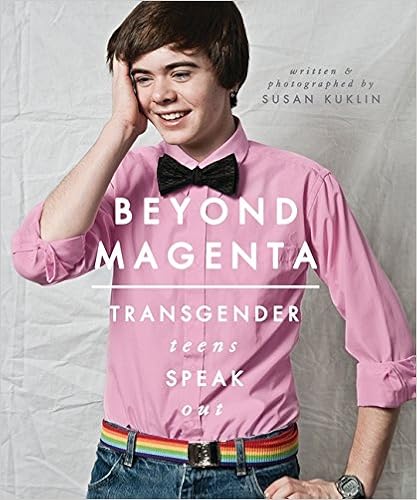
Beyond Magenta, by Susan Kuklin


Author and photographer: Susan Kuklin
Lexile Level: HL600L
Genre: Nonfiction, “Sexual Orientation”
Kuklin, Susan. Beyond magenta: transgender teens speak out. Somerville: Candlewick Press, 2014. Print.
ISBN: 978-0-7636-5611-9
Recommended for:  Grades 7- 12
Also by Kuklin:       
No chairboy:Murder, Violence and Teenagers
Teenagers on Death Row
Summary: The author, Susan Kuklin, met and interviewed six transgender or gender-neutral young adults and respectfully recorded their stories in this nonbiased nonfiction book. She also took pictures of those that consented to give them and it adds to the authenticity of the story. Each of the teens’ situations is different and the book gives much insight in their lives. We find out about their childhood days and habits. We learn about their challenges in school and with their friends before and after their transformation. We read about each of their parents and their reactions to the teens’ decisions. This book answers some of the toughest questions about teen gender issues and is great read to both teens and adults.
Selling Tool: (Book Review)
This book was actually better than I thought it would be when picking it up. I was always wondering about the issues of transgender and homosexuality and this non-fiction book answered some of my toughest questions so I’m glad I picked it up. It gives testimonies of six transgender teens and their journey to joining a transgender community. The stories come with nice colorful pictures that add to the reality and at times, little sadness of the book.
The book is superbly and totally non judgmentally written. The highlight of the book is a poem by one of the teens, Luke. The poem is about the pressure to choose between two colors, pink or blue, representing genders. His answer was: “I’m a real nice color of magenta”.
This is a great book to use when discussing gender topics among teens. If you, like me, ever wondered why people want to be a different gender than they were from the beginning, this is a book for you.  If you ever wondered what transformation they have to go through, (both mental and physical), to get to their set goal, you will find your answers here as well. I love that it is nonfiction, which adds to the authenticity and makes it so clear that the family upbringing and childhood habits have a big part in the child’s life and future decisions.
Activity: The students will write questions they would ask a transgender teen.
Goal: students will understand the background and events of transgender teens’ lives that lead to their decisions to change who they wanted to be.
Standards: CCSS.ELA-LITERACY.RL.9-10.3
Analyze how complex characters (e.g., those with multiple or conflicting motivations) develop over the course of a text, interact with other characters, and advance the plot or develop the theme.
Objective:
·         Using the book, the students will pick a person from the book and write 3 things that happened in their life of transformation.

Outcomes: students will be able to make conclusions and inferences when talking about sensitive topics in the future reads.