Showing posts with label Biography. Show all posts

Monday, December 18, 2017

America's First Ladies: Campaign Buttons and A Learning Activity

By: Charlene V. Martoni

91alp+y9qRL.jpgTitle: A Kid's Guide to America's First Ladies
Author: Kathleen Krull
Illustrator: DiVito, Anna
Genre: Informational, nonfiction, biography, history
Age Range: 8-12
Grade Level: 3-7
Lexile Level: 1090


MLA 8 Citation: Krull, Kathleen. A Kid’s Guide to America’s First Ladies. Harper Collins, 2017.

CLICK HERE FOR THE FULL SLIDESHOW😀

CLICK HERE FOR THE LEARNING ACTIVITY OUTLINE.

SELLING TOOL: Campaign Buttons

20171015_193752.jpg 

Ugly: A Read Aloud

By: Charlene V. Martoni


TitleUgly
Author: Robert Hoge
Genre: Autobiography, memoir, disability
Age Range: 8-12
Grade Level: 3-7
Lexile Level: 890L


MLA 8 Citation: Hoge, Robert. Ugly. Hachette Publishing, 2015.

CLICK HERE FOR THE FULL SLIDESHOW😀

CLICK HERE FOR THE LEARNING ACTIVITY OUTLINE.

BOOK TALK:


Barbed Wire Baseball written by Marissa Moss, Illustrated by Yuko Shimizu


Barbed Wire Baseball
Author Marissa Moss, Illustrator Yuko Shimizu
800L

                This is a retelling of the experience of Kenichi Zenimura during the Japanese Internment during World War II in the southwest of the United States. This story covers when Zeni was young, how he aspired to play baseball, how he achieved his goals as an adult, and lastly how he kept his dream of baseball alive for his sons and himself while his family was imprisoned within the internment camp.

Learning Activity:
After reading through the story, the student will look over a preselected set of images from Ansel Adams’ collection of photographs from the Manzanar Relocation Center in 1943. These images will be scenes of the baseball games, children doing activities, and families together outdoors. From these images, the student will compare the images from the book to what the real photographs were like. The student will write about what is similar and what is different between the two depictions of the events at the Japanese Internment camps.

Standards:
CCSS.ELA-L.RL.4.1 - Refer to details and examples in a text when explaining what the text says explicitly and when drawing inferences from the text.
CCSS.ELA-L.RL.4.7 - Make connections between the text of a story or drama and a visual or oral presentation of the text, identifying where each version reflects specific descriptions and directions in the text.

Goal:
The student will write a compare and contrast about the real images from the historic event of the book with the drawn illustrations and fictionalized story.

Objective:
Cognitive –
                The student will observe the drawn imagery and find similarities between the illustrations and the photographs of the events.
                The student will then write about what is different between the two images.

Outcome:
The student will listen to the book, look through the selected historical photographs about the topic of the book, compare and contrast the book to the real-life images. The student will write about the differences between the two.

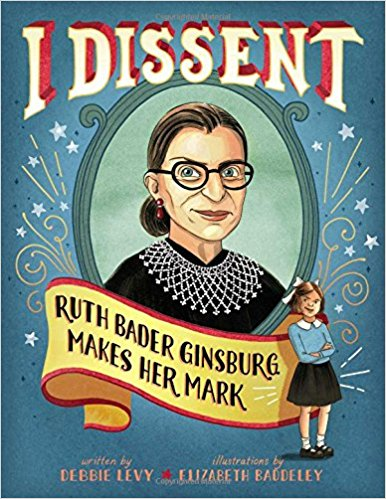
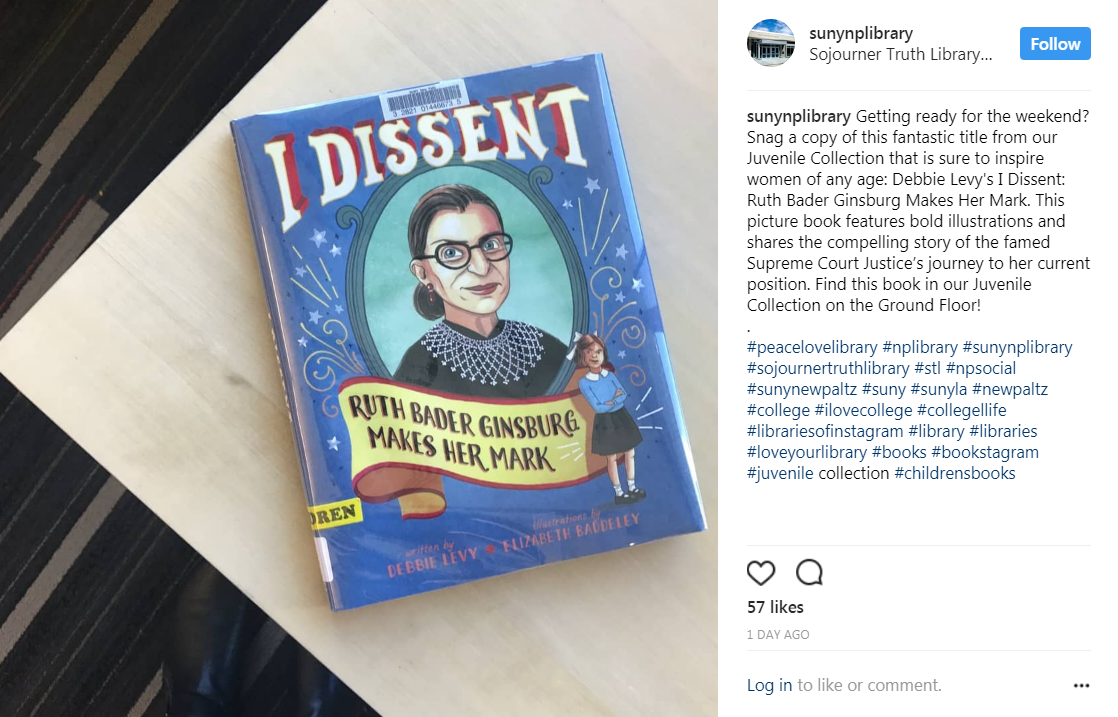
I Dissent: Ruth Bader Ginsburg Makes Her Mark (A #Bookstagram and Learning Activity)

By: Charlene V. Martoni

TitleI Dissent: Ruth Bader Ginsburg Makes Her Mark
Author: Debbie Levey
Illustrator: Elizabeth Baddeley
Genre: Picture book, nonfiction, biography
Age Range: 4-8
Grade Level: PreK-3
Lexile Level: 710L
Main lesson(s): Ruth Bader Ginsburg never let anything stop her from making her mark: not her heritage, not her gender, and certainly not the law. Ginsburg fought against social injustice by becoming a lawyer, something uncommon for a girl at the time. One day, she was asked by then-President Bill Clinton to be a Supreme Court Justice—the first Jewish woman on the nation’s highest court. Ginsburg persistently dissented against court rulings that she did not agree with, but that never got in the way of her positive working relationships with other Supreme Court Justices.

MLA 8 Citation: Levey, Debbie. I Dissent: Ruth Bader Ginsburg Makes Her Mark. Simon & Schuster Books for Young Children, 2016.

CLICK HERE FOR THE FULL SLIDESHOW😀

CLICK HERE FOR THE LEARNING ACTIVITY OUTLINE

SELLING TOOL: A #Bookstagram

Capture.PNG


Sunday, December 17, 2017

The librarian of Basra : a true story from Iraq by: Jeanette Winter


Title: The librarian of Basra : a true story from Iraq 

Author: Jeanette Winter


Lexile Level: 640 Adult-directed text

Recommended for:

Age: 4 - 7 years
Grade: Kindergarten – 3rd Grade

Summary

The book titled Title: The Librarian of Basra: a true story from Iraq by Jeanette Winter focuses on the depiction of the story of the Librarian of Basra named Alia Muhammad Baker, who took action to save the books of the library, which was located in a port city in Iraq.


The text depicts how the Librarian of Basra risked her life and took action by hiding books at her home. Initially, she asks permission to safely store the books elsewhere, due to her worries of the war causing the destruction of these invaluable reduces including “ancient” books.

Text

I believe that the pace of the story is well-paced. The text allows readers to become engaged with its story, in order to find out what happens next. The colorful illustrations match well with the text.

Illustrations

The illustrations in this text display colorful illustrations in the folk style, through this informative text.


Learning Standards

“1.  Ask and answer questions to demonstrate understanding of a text, referring explicitly to the text as the basis for the answers.”

“3. Describe the relationship between a series of historical events, scientific ideas or concepts, or steps in technical procedures in a text, using language that pertains to time, sequence, and cause/effect”.

“6. Distinguish their own point of view from that of the author of a text. ” 
(Reading Standards for Informational Text K–5: Grade 3 students)

“1.1.2  Use prior and background knowledge as context for new learning.”
“2.3.1  Connect understanding to the real world.”

 (AASL Standards for the 21st-Century Learner)

Learning Objectives

·      Students will identify the overall structure of a story through its story elements in the text. (Cognitive)
·      Students will apply prior knowledge about books and libraries to their own lives(Cognitive)
·      Students will apply the knowledge they obtained about books and libraries in this lesson to their own lives. (Cognitive)
·      Students will conduct research famous ancient libraries, such as the Library of Alexandria. (Cognitive)
·      Students will describe that their chosen library's basic features and compare it to their local library in the community, in a class discussion. (Cognitive)

·      Students will create their own book about their local library to show its importance. (Psychomotor and Affective)

Learning Activity

This learning activity will include the following three components:

·      Students learning what their local public library possesses, through a class visit, to learn how its presence in the community has a positive influence.
·      Students will utilize online and print resources to research famous ancient libraries and compare them to libraries in his/her community. 
·      Students will create their own book about libraries, to depict their own viewpoint on how their local library influences their own lives.
·      This activity connects the reading of this book into an activity that supports the English Language Arts-Literacy Learning Standards and the AASL Standards.

Learning Outcome

Students will be assessed by their level of creativity utilized to create their book about their local library. Their own point of view tells a story of how access to information is valuable and impacts society. The learning activity is tied to the book titled The Librarian of Basra by: Jeanette Winter, because through the protagonist’s words and actions how important it was to save the books in the library within the war-torn nation of Iraq.

Selling Tool: 


References

AASL. (2017, May 12). Standards for the 21st-Century Learner. Retrieved October 10, 2017,  from http://www.ala.org/aasl/standards/learning

Lesson Plan for The Librarian of Basra By Shari Lossou-Lossavi (n.d.). Retrieved October 10, 2017, from https://cmes.arizona.edu/sites/cmes.arizona.edu/files/The%20Librarian%20of%20Basra.pdf

Lexile Levels Made Easy. (n.d.). Retrieved October 8, 2017, from http://www.scholastic.com/parents/resources/article/book-selection-tips/lexile-levels-made-easy

Mid-Hudson Library System –The Librarian of Basra: A True Story from Iraq/ Jeanette Winter. (n.d.). Retrieved October 8, 2017, from https://search.midhudsonlibraries.org/iii/encore/record/C__Rb1667712__Slibrarian%20of%20basra__Orightresult__U__X7?lang=eng&suite=cobalt

New York State P-12 Common Core Learning Standards for English Language Arts and Literacy. (n.d.). Retrieved October 9, 2017, from https://www.engageny.org/resource/new-york-state-p-12-common-core-learning-standards-for-english-language-arts-and-literacy

The Librarian of Basra: A True Story from ... (n.d.). Retrieved October 09, 2017, from https://fab.lexile.com/book/details/9780152054458/


Saturday, December 16, 2017

The Right Word, Roget and His Thesaurus by Jennifer Bryant and Melissa Sweet

(courtesy of amazon.com)
Title: The Right Word, Roget and His Thesaurus
Author: Jennifer Bryant, Melissa Sweet
Awards: Caldecott Honor, Sibert Medal
Summary:
An incredibly imaginative biography of Peter Roget, the founder of the thesaurus. At every page this book illuminates the life and work of Roget and his efforts to bring a comprehensive book of words to the public.

Activity:
Students will create a mini thesaurus based on the works of peter roget.

Learning Standard:
CCLS.L.G5.1: Demonstrate command of the conventions of standard English grammar and usage when writing or speaking.

Learning Goal:
 will use reference texts to broaden vocabulary.

Learning Objective:
Students will research five words and find their word relationships by using Roget's thesaurus.

Learning Outcome
STudents will broaden vocabulary through the use of reference texts.

Anything but Ordinary Addie by Mara Rockliff and Iacopo Bruno

((courtesy of amazon.com)
Title: Anything but Ordinary Addie: The True Story of Adelaide Herrmann, Queen of Magic
Author: Mara Rockliff, Illustrated by Iacopo Bruno
Summary:
The biography of Adelaide Herrmann a woman who wanted to be more the ordinary, much more. Learn about this pioneer of stage magic who dared to defy the ordinary, and became extraordinary.

Activity:
Students will be introduced to the concept of primary sources as a means of developing biography. Students will interview each other in a fill in the blank style format in the guise of a newspaper headline. *I’ve actually done this project for a group of 2nd year students, I found it very effective.

Learning Standard:
CCLS.Re.G2.1:Ask and answer such questions as who, what, where, when, why, and how to demonstrate understanding of key details in a text.

Learning Goal:
Students will be introduced to the concept of primary sources.

Learning Objective:
Students will interview each other for important details about their day including what, where, and when.

Learning Outcome:
Students will conduct interviews illustrating the concept of primary sources.

Follow The Dream: The Story of Christopher Columbus by Peter Sis


Click Below For a Larger View:

https://drive.google.com/file/d/1vMh-QVwi26nDusVdrL6u2wvA6Ah7wUTi/view?usp=sharing

Just being Audrey by Margaret Cardillo ; illustrated By Julia Denos


 Who was Audrey Hepburn? Was she a WWII survivor, an actress, a fashion icon or a humanitarian? Find out!


Do you want your students to learn who was Audrey Hepburn?
 
Try this book that is geared towards elementary and middle school children.

This book focuses on Audrey Hepburn’s on her life during the  Nazi-occupied Netherlands in  World War II.

In addition, it focuses on her rise to stardom in the popular films in the 1950s and 1960s, and friendship with reknown designer Hubert de Givenchy.

Her Goodwill ambassadorship for UNICEF is also discussed, which she was inspired by her own experiences, incuding the Dutch Famine, during the war.


Title: Just being Audrey

Author: Margaret Cardillo, Margaret

Illustrator: Denos, Julia

Publisher: Balzer + Bray

Lexile Level:  740

Ages: 4-8


Grades: Preschool to 3rd Grade


Learning Standard

“3. Describe the relationship between a series of historical events, scientific ideas or concepts, or steps in technical procedures in a text, using language that pertains to time, sequence, and cause/effect.” (Reading Standards for Literature K–5)
Learning Goal

Students will gather information to create a script after reading the text titled Just Being Audrey by Margaret Cardillo.

Learning Objective

Students will conduct research about Audrey Hepburn's life by utilizing at least 3 credible sources of information in order to create a script that will focus on an aspect of her life that they believe is important. (Cognitive and Affective)

Students will create a script based on what they believe is the most important aspect to focus on about what they have learned from Audrey Hepburn’s life. (Psychomotor and Affective)

Learning Domain

Cognitive, Psychomotor and Affective

Learning Activity

Students will create their script and perform in teams to demonstrate their own portrayal of Audrey Hepburn’s life. Students will discuss what they have learned throughout their research and through the viewing of the performances. Students will be assessed with a rubric based on their ability to identify and evaluate sources of information, their performance as a team as well as their individual participation.

Learning Outcome

Students will create a script and perform in teams, to demonstrate their portrayal of Audrey Hepburn’s life, after reading the text titled Just Being Audrey by: Margaret Cardillo.

Selling Tool


Poster (Shown Above)

References

Cardillo, M., & Denos, J. (2011). Just being Audrey. New York: Balzer Bray.

New York State P-12 Common Core Learning Standards for English Language Arts and Literacy. (n.d.). Retrieved October 25, 2017, from https://www.engageny.org/resource/new-york-state-p-12-common-core-learning-standards-for-english-language-arts-and-literacy