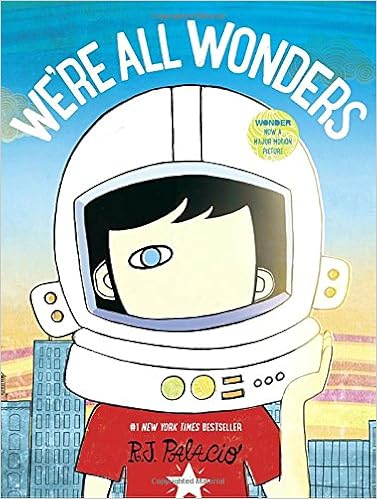
By RJ Palacio
Palacio, R.J. (2017). We're All Wonders. New York, NY: Alfred Knoff.
 Summary
This children’s picture book is based on the novel Wonder by RJ Polacio. We’re All Wonders explores the same theme as Wonder but it is presented in a way children can understand and relate to. Auggie looks different from the other children. Because of this, he is not accepted by his peer group. The book explores Auggie’s feelings of rejection and confusion because he doesn’t understand why it is a bad thing to be different. Using beautiful illustrations to enhance the story, the reader gets a sense that it is ok to be different.
Lexile Level: AD370L
Grades: k-2nd
Domain: Affective
Health Education Skills:
SM.E.2: Identifies the attributes (knowledge, skills, competencies) of a safe and healthy person
FLS.E.7: Individuals are unique and special and deserve to be treated with respect.
New York State Health Education Standards:
1. Personal Health and Fitness
2. A Safe and Healthy Environment
Health Education has learning standards but is also a skills based discipline.
Goal:
Students identify differences and similarities within their own classmates. Students will develop a positive regard for others by discovering and appreciating the characteristics that are different and the same from person to person.
Objectives:
Students will identify the uniqueness of individuals in class, including physical characteristics, behaviors, talents, and feelings.
Students will discuss the importance of accepting others in a group setting.
Students will develop a positive regard for others by discovering and appreciating the characteristics that are different and the same from person to person.
Outcome: Students will create a Mr/Mrs Potato Head. Students will compare their creation to other students creations and identify two differences and two similarities.
Procedure:
Read the story, We’re all Wonders by RJ Palacio.
Ask the children to look around the room and observe how people are the same and different. Now we are going to play a game. As the teachers calls out different characteristics, (in first grade, goes to specific elementary school, has two eyes, has a belly button, likes certain activities), the student will stand up if it applies to them. We will count how many have each characteristic. Ask students if it is ok if they don’t all like the same things? Guide the students to understand it is ok if they are different or the same as each other – they are all special.
Explain that the students will be broken into small groups. Each group will get a potato head and various parts of the potato head. Each student in the group will have an opportunity to put on a part of the potato head. When each person in the group has had chance to put a piece on the potato head and all the parts have been put on, the potato heads will be collected.
The students will then have a chance to see each of the potato heads. Ask the class to pick out the ways the potatoes are similar and then ask ways that the potatoes are different.
Explain that we all have similarities and differences that can be seen; there can be similarities and differences that cannot be seen. A piece of paper with a special skill, health concern and/or challenge should have been placed inside each potato head. Examples: “I love to read”, “Math is a challenge for me”, “I have asthma and need extra time when I run”, “I am allergic to peanuts”. Open the backs of each potato head. Read the piece of paper that is found in each one. Explain how each potato head has differences that can’t be seen, you may not know that the potato head has this difference.
Explain how each group started with the same thing, a potato head, but each groups finished result is different. Explain how each one of them starts as a tiny baby but as they grew, each one of the look, feel, and act different from each other.
Conclusion: Even though we may be different from each other, we should always RESPECT each other and treat everyone with kindness.
Selling Tool

Zamudio, Monica. “View a plan.” Hotchalk Lesson Plans Page: Lesson plans by teachers for teachers, lessonplanspage.com/pemrandmrspotatoheadindividualdifferencesk1-htm/.