Uni The Unicorn and The Dream Come True
Amy Rosenthal and Brigette Barrager
AD640L
The
follow up story to Uni the Unicorn,
this continues the story of Uni and her human girl best friend. They are
separated by the rainbow magic that keeps the unicorn world apart from the
human world. They find a way to overcome their troubles and be together.
Learning Activity:
The students will listen to the story as read by the teacher and after the
story they will answer how the weather in the story made the characters feel.
Standards:
CCSS.ELA-L.RL.1.4 - Identify words and phrases in stories or poems that suggest
feelings or appeal to the senses.
CCSS.ELA-L.RL.1.7 - Use illustrations and details in a story to describe its
characters, setting, or events.
Goal:
The students will listen to the story and come to see how the setting
illustrations represent the same mood that the text is describing.
Objective:
Cognitive -
The
students will listen to the story and be able to answer questions orally to the
teacher about the weather within the story.
They will answer what type of weather was used in a scene.
Affective -
They
will be able to describe the scene and characters involved and how the weather
reflects their feelings at that time. They will answer why that type of weather
is used for that scene and how they would feel during it (raining, sunny,
stormy).
Outcome:
The students will listen to the story and look at the illustrations to see how
the author/illustrator uses the weather to show how the characters feel.
Ella recently has moved next door to the abandoned remains of the orphanage Thornhill. Seemingly abandoned by her family Ella begins investigating the ruins of the orphanage only to find a journal written by the orphan Mary. Years earlier Mary is scorned and shunned by the girls of Thornhill and has only her puppets and a journal to keep her company. In this time jumping graphic novel Mary and Ella become irrevocably connected for better or worse.
Mary’s story has no dialogue but is revealed through full page panels, Anna’s tale is told through journal entries, both tales come together at the end to make the whole. A student project would be to create a one page story that has two perspectives or two characters, than relate the story of each in two different forms that form the whole of the story.
Learning Standards: AASL Personal and Aesthetic Growth 4.1.3: Respond to literature and creative expressions of ideas in various formats and genres. Learning Goal: Students will create comparative creative works founded in the examples of past readings. Learning Objective: Students will use the structural example provided by Thornhill to produce a unique work of literature or art in the same comparative theme. Learning Outcome: Students will more deeply understand how written and visual communication can be a compilation of many forms that inform the whole.
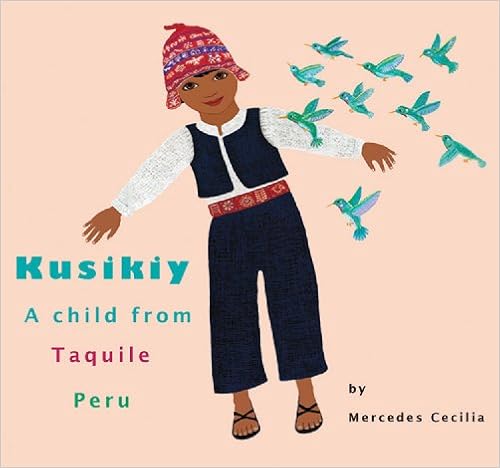
Cecilia, Mercedes. Kusikiy: A Child from Taquile, Peru. Keepers of Wisdom and Peace Books, 2010.
Lexile Level: 650L
Book Trailer:
Kusikiy: A Child from Taquile, Peru
tells the story of young boy named Kusikiy. He lives in a small
village on the island of Taquile, in the center of Lake Titicaca.
The village's community has been living a traditional life of
farming, crafting, and animal husbandry, as was taught to their
ancestors by the great spirits that watch over the island. This
year, the rainy season is late on arriving, causing many of the
island's inhabitants to fear that their crops are in danger.
Kusikiy's grandfather tells Kusikiy about the Great Mountain Spirit,
giving Kusikiy the idea to ask the spirit for help. Kusikiy sets off
on an adventure in order to help his village by restoring the rains
that they so desperately need.
Learning Activity
After
reading Kusikiy
together as a class, students will take some time to answer a few
questions about the book in written form. For example: What are some
folktales/myths that you heard during the reading? How did those
myths/folktales affect the people of Taquile? How did Kusikiy use
the folktales/myths of his culture to help his community? How do
some of the folktales/myths compare to stories/folktales that you
have heard before? After collecting our thoughts, we will reconvene
as a class to discuss what we found and share our ideas.
Learning Standard:
CCSS.ELA-LITERACY.RL.3.2
- Recount
stories, including fables, folktales, and myths from diverse
cultures; determine the central message, lesson, or moral and explain
how it is conveyed through key details in the text.
Goal
Kusikiy:
A Child from Taquile, Peru
is essentially a folktale about a child embracing the folktales of
his culture. The author uses the elders of the village to describe
several Taquile fables and folktales to Kusikiy. The goal here is to
encourage students to consider the legends and fables of a different
culture, ideally in comparison to similar ones from their own
culture.
Objective
The
objective of this activity is to help students process the various
folktales told in the book, as well as to organize and identify them,
as well as compare them to folktales they have heard from other
sources.
Outcome
During
our discussion, students should be able to identify multiple
folktales from the story. They should also be able to describe how
the island's residents, as they are portrayed in the text, have
modeled their lives after the lessons taught by their folktales.
Finally, students should be able to link the folktales heard in the
story with folktales that they are already familiar with, primarily
in terms of the lessons that they teach.
Summary: This book compares a day in the life of two children in two parts of the world, Morocco and Australia. The actual book design is quite different from most typical books. The book is actually two books in one. When you open the book, each side of the open book is about one world either Morocco or Australia. This style allows the reader to see the parallels between the children’s lives. The introduction for the Moroccan side is in Arabic while the Australian side of the book’s introduction is in English.
Standards
CCSS.ELA-LITERACY.RL.1.9 Compare and contrast the adventures and experiences of characters in stories.
Goal:
Students will gain an appreciation, tolerance and respect for other nationalities, ethnicities, and cultures.
Objective: Students will identify two differences and two similarities between the daily activities of the two children in Mirror. Students will identify the similarities and differences between their daily life and the daily life of a child in urban Australia. Students will identify the differences and similarities between their daily life and the daily life of a child in the Moroccan desert.
Outcome: Students will compare the differences and similarities between life in the Moroccan desert and life in urban Australia by completing a VENN diagram. Students will compare the differences and similarities between life in the Moroccan desert or urban Australia and their life by completing a VENN diagram.
Procedure:
Start by asking the students these questions:
What would it be like to grow up in a different country?
Do they do the same things as we do?
What does their world look like?
Read the book Mirrors to the students. Students will work in pairs and discuss the differences and similarities they find. Each student group will share some of the differences and similarities that they found between life in the Moroccan desert and urban Australia. The teacher will guide the whole class as they create a VENN diagram to highlight these differences and similarities. The students will then create their own VENN diagram by comparing their life to either life in the Moroccan desert or urban Australia.
*This book could also be used for Social Studies in a variety of ways.
Read alikes:
Material World: A Global Family Portrait by Peter Menzel
What the World Eats by Faith D’Aluisio
Wake Up World! A Day in the Life of Children Around the World by Beverly Hollyer
Awards for Mirror:
Children's Book Council of Australia
Picture Book of the Year 2011
Australian Indie Award
Best Children's Book 2011
The English Assoc and the UK Literary Assoc 4-11 Award
Best Children's Illustrated Book (non fiction) 2011
By O.T. Nelson
Nelson, O. T. The girl who owned a city. Bantam Doubleday Dell Publishing, 1975.
Summary
A virus that only affected people above the age 12 wipes out all the adults in the world. Lisa and her younger brother struggle to stay alive by scavenging for food among forgotten and abandoned houses and businesses. At night, Lisa and her brother barricade themselves inside their house in order to protect themselves from gangs of children. Lisa realizes to stay safe, she must team up with the other children on her street to protect themselves against a roaming gang that has been terrorizing them. Lisa becomes the leader of the group and devises a way to keep them safe. She comes up with the idea of creating a fortress. She and the children move to a local high school and turn it into a fortress. Many children join her and their fortress becomes a city. Her leadership is challenged by a gang of children and she must fight for her city.
Lexile Level: 660L
Grades: 4-6
Domains: Affective
Standards
CCSS.ELA-LITERACY.RI.5.3
Explain the relationships or interactions between two or more individuals, events, ideas, or concepts in a historical, scientific, or technical text based on specific information in the text.
CCSS.ELA-LITERACY.RI.5.8
Explain how an author uses reasons and evidence to support particular points in a text, identifying which reasons and evidence support which point(s).
Goal
Students will understand the evolution of characters in a novel.
Objectives
Students will understand the characteristics that two characters display at the beginning and end of a novel.
Outcome
Students will complete a character map for two characters. The character map includes personality traits, how the character interacts with other characters in the novel, how the character influences the storyline, and changes that occur to the characters by the end of the novel. They must include evidence from the book to support their answers.
Selling Tool:
Even though I did not make this book trailer, I thought it was an excellent way to promote the book to students.
Jackson, his little sister, his mom and dad and their dog have to live in the family’s minivan for a few weeks. The family does not have much money not even for food. During all of this, Jackson’s imaginary friend from childhood, a oversized cat named Crenshaw comes back in his life to help him. His family eventually saves enough money to rent a new apartment but they are soon at risk of losing the new apartment. Jackson feels angry at his parents for their situation but he also feels bad for them. He really wants to know what is happening but his parents don’t always tell him the truth.
Goals:Students will be able to recognize that a book often doesn’t answer all of our questions and experience evaluating what they still want to know by writing to an author and giving reasons for each question.
Outcomes: Students will write a letter to Jeff Kinney including questions they have regarding the book Diary of a Wimpy Kid. Students will include an introduction, questions with reasons, and a conclusion. Students will give themselves feedback and a peer feedback and use that to edit and revise their letter.
Objectives:
Students will be able to write a letter to an author including an introduction, at least three question paragraphs, and a conclusion.
Students will be able to provide support for their questions by giving support from the book or their own life.
Students will be able to use the feedback form to give specific feedback to their peer.
Students will be able to edit and revise their own writing based on their self and peer feedback.
Learning Activity:
Students in a fourth grade class will read Diary of a Wimpy Kid in guided reading groups, discussing each section of the book together. The teacher will give vocabulary lessons as needed based on the level of the group. When the class is finished reading they will come together and discuss how they feel about the book.
The teacher will say, “I feel like I wish I knew…” and “I wonder why Jeff Kinney did…” and so on. Students will be given time to share with peers questions that they still have about the book, or why the author did something.
The teacher will explain that writing to an author is something that even adults do. The teacher will guide the class through expectations of writing to an author, including using proper grammar, spelling, an introduction which introduces yourself and why you are writing, and that each question should include reasons for asking. Lastly, it should include a proper conclusion, thanking the author and hoping to hear from them. (Revising and Editing has already been taught using This Form)
Students will be asked to reread their writing and give themself feedback using the Feedback Form. This allows students time to fix any mistakes they have made before sharing. Students will then be put into pairs and asked to read each other’s letter separately. Pairs will use the Feedback Form to give feedback to their peer, but not write corrections on their paper. Students will return forms and have time to revise and edit their work a second time. (Students use blue pen for edit and red for revise before rewriting so that their effort is clear to the teacher).
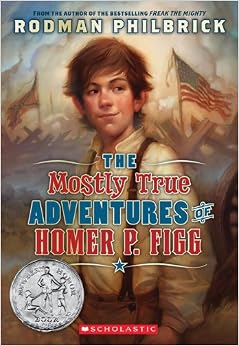
Philbrick, Rodman. The Mostly True Adventures of Homer P. Figg. Scholastic, 2009.
Lexile Level: 950L
Selling Tool
*** Please Note, the book trailer was created by Tyler Weigand, this is not my work**
Possible learning activity
Students will research the Civil War Era to make a case about whether they feel that the novel is an accurate portrayal of the time period, and to determine if the adventures Homer had could have happened, or if they are completely unrealistic.
Standards
CCSS.ELA.RL.4.1. Refer to details and examples in a text when explaining what the text says explicitly and when drawing inferences from the text.
CCSS.ELA.RI.4.1. Refer to details and examples in a text when explaining what the text says explicitly and when drawing inferences from the text.
CCSS.ELA.RI.4.9. Integrate information from two texts on the same topic in order to write or speak about the subject knowledgeably.
CCSS.ELA.W.4.2. Write informative/explanatory texts to examine a topic and convey ideas and information clearly.
Goal
Students will make connections between literature and real life, including historical events.
Objectives
Students will identify 3 details and quotes from The Mostly True Adventures of Homer P Figg that can be verified using research (Cognitive)
Students will identify details and examples from nonfiction texts that support or refute the events from The Mostly True Adventures of Homer P Figg(Cognitive)
Students will select and use at least 3 sources of information in their research outside of The Mostly True Adventures of Homer P Figg (Cognitive)
Students will write a logical argument for whether or not the events in The Mostly True Adventures of Homer P Figg are an accurate portrayal of the Civil War Era (Cognitive)
Outcomes
Students will craft an argument about whether the events as portrayed in The Mostly True Adventures of Homer P Figg are an accurate representation of life in the Civil War Era