Wednesday, November 15, 2017

Ship Breaker

“Ship Breaker”  by Paolo Bacigalupi

Bacigalupi, Paolo. Ship Breaker. New York: Little Brown Books, 2010.
Lexile: 870
Recommended for: Grades 5-7
Book Selling Tool: Book Review
Summary: Nailer is a teenage boy who works the light crew on a ship. He works aimlessly day in and out  scavenging for copper wiring just to make quota--and hopefully live to see another day. But when he discovers an ex clipper ship beached during a recent hurricane, he faces the most important decision of his life:  Strip the entire ship for all it's worth or rescue its only survivor, a beautiful, rich girl who could lead him to a better life. This book is classified Science fiction
Activity: This book would be great to use in the classroom as an Science Research Project.  The clipper ships in Ship Breaker gives students insight to technology and the entire technology era. I would have students use multiple nonfiction text to investigate and research the means that engineers and scientists are currently using to improve technology.

Students will then create an 3D object replica of one of the advances in technology on the 3D Printers using the information learned in their research. They will present their 3D replicas with two or more pieces of evidence to support why their technology is beneficial to the 21st Century to improve conditions. Presentations will be assessed through a rubric  Here is the graphic organizer used for research https://docs.google.com/document/d/14SKov9545GyB9BIxhv3GHYKNomkPmSBycblicFU91Hw/edit?usp=sharing
Standards:
Common Core Standards: Presentation of Knowledge and Ideas:
Present claims and findings, emphasizing salient points in a focused, coherent manner with pertinent descriptions, facts, details, and examples; use appropriate eye contact, adequate volume, and clear pronunciation.
Include multimedia components and visual displays in presentations to clarify claims and findings and emphasize salient points.


AASL:
7.6 Interprets information and ideas by defining, classifying, and inferring


Work Cited:
 Book Rags.com, Book Activity.  Retrieved on November 11, 2017 from http://www.bookrags.com/lessonplan/ship-breaker/#gsc.tab=0  


Doug Unplugged

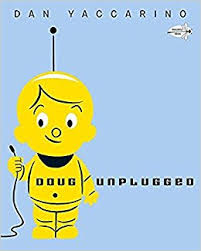
Doug Unplugged By Dan Yaccarino

Yaccarino Dan. Doug Unplugged. New York: Knopf Books for Young Readers, 2013.


Lexile Level: 630
Grades: 3-5
Summary: This is a story about Doug, who is a robot. The problem is his parents want him to be smart, so each morning they plug him in and automatically start the information flowing and downloading. After Doug spends a morning learning facts about the city, he decides he wants to learn even more by going outside and exploring it on his own. He ends up getting into a day of adventure and discovery. Doug learns amazing things when he is unplugged and above all, being able to interact and make a new friend.
Selling Tool: Infographic
Learning activity: ELA- Writing Opinion Pieces using Text Evidence
Students will read Doug Unplugged and discuss question after reading, Do you think kids spend too much time on computers?
Students will then choose a side to develop a thesis to start researching for writing an opinion piece based on evidence from the text.  Students will be using the website, Wonderopolis to search for articles to get their textual evidence.


They will write down their claim, and give three details (reasons) from the text to support their claim, and they will expand in their own words what the details mean to them. Students will fill out a graphic organizer first with their research, then write or speak their Opinion writing through the use of an online Voki. The Voki will also be used as a tool for students to edit/revise their work


Learning Goal: Students will be able to write an opinion piece using three pieces of evidence from the text to support their claims. They will then present their opinion pieces through the technology tool, Voki.


Learning Objectives:
  • Students will identify a claim along with three pieces of text evidence to support their claim of “Too much time spent on computers a bad thing.” OR “Spending time on the computer has positive benefits for kids.”  on their Opinion Graphic Organizers(Cognitive).


  • Students will present their opinion writing by being able to speak or write to create  an online avatar called, Voki (Cognitive and Psychomotor).


Learning Standards:
CC Standards:Text Types and Purposes:
Write opinion pieces on topics or texts, supporting a point of view with reasons.
Introduce the topic or text they are writing about, state an opinion, and create an organizational structure that lists reasons.


Information Fluency Continuum:
5.3 Selects and uses multiple appropriate print, nonprint, electronic, and human sources to answer questions.
5.6 Uses various note taking strategies (e.g., outlining, underlining, bulleted lists, highlighting, graphic organizers)


American Association School Library:
4 Find, evaluate, and select appropriate sources to answer questions.
2.4.1 Determine how to act on information (accept, reject, modify).


The Crossover


“The Crossover” by Kwame Alexander

Alexander, Kwame.  The Crossover.  New York: HMH Books For Young Readers, 2014.
Summary: This is a story told completely in poetic verse about twelve year old twins Josh and Jordan who are kings on the basketball court. Josh develops a hobby that is more than basketball- it is his rap and beats too. Things begin to change when the twins’ winning season ends. Jordan meets a girl, and the relationship between brothers starts to diminish. They start growing apart and realize that when they start breaking the rules, consequences soon follow. The novel is told in poetic verse that adds an element of depth to this family.  


Selling Tool: Infographic


Lexile:750   Grades: 3-5
Curricular Uses: ELA Activity on Identity and Character Development
This book could  be used to teach identity and character development with a 5th grade class. Students read and visualize what each of the characters (JB, Filthy McNasty, Mom, Dad) look like and act based on the evidence from the story of what they read.
As students read this verse novel I would have them encourage them to visualize each of the main characters and talk about what they look like and how they talk and act. Students would be encouraged to draw character sketches or find magazines or web images that look like these characters:  Students will fill out a Snapshot on each character. They will then scan and upload their Snapshots to a class blog where they will read and debate each of their peers’ snapshots based on their own analysis of the story.

Standards:
Common Core: Key Idea and Details

Key Ideas and Details:

CCSS.ELA-LITERACY.RL.5.1 Quote accurately from a text when explaining what the text says explicitly and when drawing inferences from the text.
AASL:
2.1.4 Use technology and other information tools to analyze and organize information.
2.1.5 Collaborate with others to exchange ideas, develop new understandings, make decisions, and solve problems.
4.1.3 Respond to literature
Information Literacy:
5.6 Uses various note taking strategies (e.g., outlining, underlining, bulleted lists, highlighting, graphic organizers).
Learning Outcomes: Students will analyze how different characters developed from beginning to end in this novel by using examples from the text. They will then create a class blog to debate and respond to other character analysis of their peers for deeper understanding and application of what they read.

Learning Objectives
  • Students will analyze character development of 3 or more characters by completing a Snapshot using text evidence. (Cognitive) 
  • Students will create a class blog in which they will respond to two or more peers on their character analysis and give reasons to support their answers.  (Psychomotor, Cognitive)


*This book would also be AWESOME to use as part of a poetry unit and use this novel to have students create their own rap poetry just like Alexander did.


Work Cited:

Upper Elementary Adventures (Teachers Pay Teachers).The Crossover by Kwame Alexander: Novel Study and Project Choice Board . Retrieved on November 27th, 2017 from https://www.teacherspayteachers.com/Product/The-Crossover-by-Kwame-Alexander-Novel-Study-Project-Choice-Board-2495278

Into the Volcano

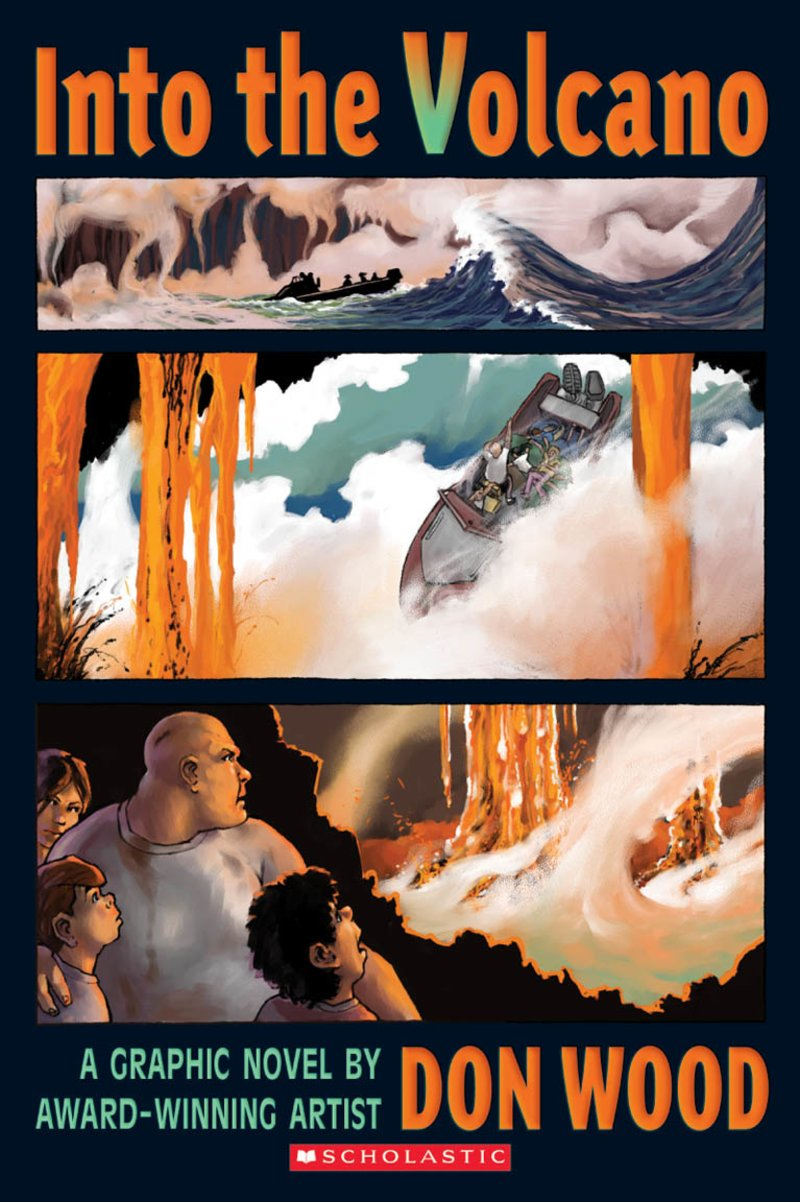
Into the Volcano  By Don Wood.

Wood, Don.  Into the Volcano. New York: Blue Sky Press, 2008.
Lexile Level: 240
Grades: 5-7
Summary: This is a graphic novel about two brothers overcoming impossible odds. The story takes place on an unexplored volcanic island where only the brave survive. The brothers are told they must travel to a volcanic island to help an aunt they have never met. When they arrive on the island, they soon discover that their aunt is up to no good. They are sent on an expedition that takes them on a wild boat ride straight into an erupting volcano.
Selling Tool: Infographic
Learning activity for the book:
Science Integration: (This project will take a few weeks to complete.) Students will read this graphic novel and research the process by which causes a volcano to erupt.  They will then use their research as an expansion while creating their own erupting volcano as apart of a chemistry unit on chemical reactions.
Students will research and fill out this Scientific Graphic Organizer using multiple text including digital and book print as well as district databases such as World Book Online, and TrueFlix for informational text. When they are done identifying the process by which a volcano erupts they will work in small groups to create a volcano of their own and explain the process from their research to their peers while making their volcanoes erupt . The volcano activity will include the following materials: a bottle, baking soda, vinegar, red food coloring, moist soil- all answering the question, What's happening in there?

The project along with the research about the process of volcanic eruptions will be assessed using this rubric (which is given to students prior to them presenting).


Learning Goal: Students will be able to explain the process by which causes a volcano to erupt while erupting their own volcano through a hands-on project.


Learning Objectives:
  • Students will identify the chemical reaction process that causes a  volcano to erupt through research and the use of a scientific graphic organizer (Cognitive).
  • Students will explain the process of volcanic eruptions through their own volcanic eruption project that will be assessed with a rubric (Cognitive and Psychomotor).
Learning Standards:
CC Standards: Integration of Knowledge and Ideas:
CCSS.ELA-LITERACY.RI.6.7
Integrate information presented in different media or formats (e.g., visually, quantitatively) as well as in words to develop a coherent understanding of a topic or issue.


Information Fluency Continuum:
5.3 Selects and uses multiple appropriate print, nonprint, electronic, and human sources to answer questions.
5.6 Uses various note taking strategies (e.g., outlining, underlining, bulleted lists, highlighting, graphic organizers)


American Association School Library:
4 Find, evaluate, and select appropriate sources to answer questions.
2.4.1 Determine how to act on information (accept, reject, modify).
3.2.3 Demonstrate teamwork by working productively with others.

Work Cited:

Teacher Workbook Series: Graphic Organizers. 2003. Retrieved on December 4, 2017 http://www.actedu.in/wp-content/uploads/2016/03/Science-Graphic-Organizers.pdf


Smile By Raina Telgemeier


Smile By Raina Telgemeier

Telgemeier, Raina.  Smile. New York: Scholastic, 2010.
Lexile Level: 410
ISBN: 0545132053
Summary: This is an autobiography of author, Raina Telgemeier’s life growing up and dealing with teeth issues. She lives by  Murphy’s law that if anything bad can happen it will.  She is a typical teenager who feels out of place with her changing body, skin, and teeth, and whose only wish is to be normal. Raina is accident prone and deals with traumas and earthquakes, friendships with her childhood girl friends, and learning how to deal with boys in middle and high school.
Book Review:  Here is my selling tool
Learning activity for the book:
Science Integration: ( This project will take a few weeks to complete.) Students will read this graphic novel and discuss the earthquake that Riana’s family experienced. They will then conduct research on that exact earthquake and others to research the causes and effects of earthquakes. Students will then compare the earthquake in the book, to that of what they researched  to to see if the earthquake was depicted accurately.
Students will work in groups to create an IMovie to explain and present their findings. Students will work independently on the research and with peers to create their IMovies. At the completion of the project, students will fill out a Strengths/Needs Google Form assessment for their overall learning- research, and teamwork skills with the project.

Learning Goal: Students will be able to create an IMovie on the causes and effects of earthquakes like the ones read about in Smile.

Learning Objective:
  • Learners will compare information learned about in Smile, to that of information learned through research to see if the book depicted the earthquake accurately by responding in their graphic organizer (Cognitive).

  • Learners will "Learners will work in groups to synthesize information about earthquakes to create an iMovie"s (Psychomotor).


Learning Standards:
CC Standards: Integration of Knowledge and Ideas:
CCSS.ELA-LITERACY.RI.5.7
Draw on information from multiple print or digital sources, demonstrating the ability to locate an answer to a question quickly or to solve a problem efficiently.
Information Fluency Continuum:
5.3 Selects and uses multiple appropriate print, nonprint, electronic, and human sources to answer questions.
5.6 Uses various note taking strategies (e.g., outlining, underlining, bulleted lists, highlighting, graphic organizers)

American Association School Library:
2.4.1 Determine how to act on information (accept, reject, modify).
3.1.4 Use technology and other information tools to organize and display knowledge and understanding in ways that others can view, use, and assess.
3.2.3 Demonstrate teamwork by working productively with other

Work Cited:

Comic Book Legal Defense Fund. Using Graphic Novels in Education:Smile. 2017. Retrieved on September 25. 2017 from http://cbldf.org/2013/12/using-graphic-novels-in-education-smile/


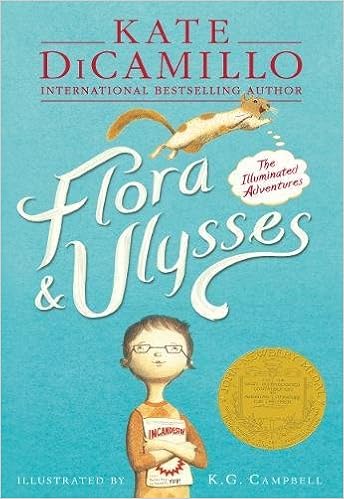
Flora and Ulysses by Kate DiCamillo


DiCamillo, Kate, and K. G. Campbell. Flora and Ulysses. Somerville, MA, Candlewick Press, 2013.
Lexile Level: 520

Image result for flora and ulysses


View Infographic Here


The Name Jar by Yangsook Choi​


Choi, Yangsook. The Name Jar. Columbus, O.H., Zaner-Bloser, 2013.

Lexile Level: 590 

Image result for the name jar


Selling Tool: Book Talk
The Name Jar Power Point


Summary: This book is about a little Korean girl who just moved from Korea to USA and started school. The students were making fun of her name on the bus and she decides to tell everyone in her class she doesn’t have a name yet. They try to help her with picking names so they made a name jar. After numerous drawings, Unhei is still unsure of what name she wants for herself. Then comes a day when the jar is gone for some reason and Unhei finally gets the courage to stand up for herself and tell everyone her name and what it means. She finally begins to like her name plus makes many new friends.

Activity (3-4 grades): After reading the book, the students will be given out a paper and a pencil and be asked to write a well thought on answer to the question of would they change their name and why. They will be asked to use complete sentences and then share their responses with the class if they wish to do so.
Standards: CCSS.ELA-LITERACY.W.4.1
Write opinion pieces on topics or texts, supporting a point of view with reasons and information.
Goal: Students will response to prompt in compete sentences
Objective: Using complete sentences, the students will write a short response to a question: if you were to change your name, what would it be and why?
Outcome: Students will be able to freely share their feelings in writing


Works Cited:

Choi, Yangsook. The Name Jar. Dragonfly Books. 2003. Print