Wednesday, November 15, 2017

Deadliest Animals

 Deadliest Animals by Melissa Stewart

Stewart, Melissa.  Deadliest Animals. New York: National Geographic Children's Books , 2011.
Lexile Level: 940
Grades: 3-5
Fountas and Pinnell: Level P


Summary: This is an informational text book about the world's most dangerous animals. With awesome illustrations and factual information students will read about over twelve  species such as sharks, snakes, jellyfish and more. These creatures are among the most threatening and interesting in the world!
Selling Tool: Infographic
Learning activity for the book:
Students will read this book and learn about Text Features through this slideshow. Students will then use this text to identify the text feature and analyze what new information they learned as a result of the text feature. They will fill out this Text Feature  Scavenger Hunt graphic organizer. Students need to find and analyze 5 or more different text features on their graphic organizers.


When students have completed their scavenger hunts, they will reflect on their learning by responding to a Text Features Blog post in which they will explain their overall learning and process with this skills in how confident they feel using graphic sources and what areas they might need help with.


Learning Goal: Students will be able to identify and interpret text features in informational text in order to learn new information about what they are reading.

Learning Objectives:
Students will be able to connect and analyze 5 different graphic sources in a nonfiction text and apply how those features helps them to better understand what their reading (Cognitive).
Students will synthesize and evaluate their learning about graphic sources by creating a blog as a self reflective exit ticket (Psychomotor, Affective)

Learning Standards:
CC Standards: Reading Literature:
Integration of Knowledge and Ideas:
R.L.4.7- Make connections between the text of a story and a visual or oral presentation of the text, identifying where each version reflects specific descriptions and directions in the text.
Reading Informational Text:
Integration of Knowledge and Ideas:
R.I. 4.7- Interpret information visually (charts, maps, diagrams, timelines) and explain how the information contributes to an understanding of the text in which is appears.


Information Fluency Continuum:
4.10 Identifies own strengths and sets goals for improvement.  


American Association School Library:
2.4.1 Determine how to act on information (accept, reject, modify).
2.4.3 Recognize new knowledge and understanding.


The Name Jar

Please see Google Slideshow for Activity. 


Work Cited:

Fourth and Ten . Story of My Name Writing and Craftivity. Retrieved on November 26th, 2017 from https://www.teacherspayteachers.com/Product/Story-of-My-Name-Writing-and-Craftivity-265034

Warriors: Into The Wild

Warriors (Book #1)  by Erin Hunter  

Hunter, Erin. Warriors: Into the Wild. New York:Harper Trophy , 2004.


Lexile Level: 790
Grades: 5-7
Summary: Rusty is  an ordinary house kitten at first. He travels into the forest and gets involved in the epic battles of the cat warrior clans who rule the entire wild.  He quickly turns into a warrior and even takes on a new name. Firepaw - and a position as a Thunderclan apprentice.  He quickly learns what it truly means to be a warrior and may turn out to be the bravest of all.
Selling Tool: Infographic
Learning activity:
Using the Book to Connect to Social Studies Unit on Ancient China- 6th grade activity
Students will use this book to compare/contrast to research on about Ancient China and chinese culture. Students will use various print and digital websites for research. They will use information from the book as well as information from their research on Ancient China to fill our graphic organizers. Students will then create a slideshow or Prezi’s to present their information and cite their sources.


Here are three topics for compare/contrast research (students can also add their own inquiry questions):


  • Respecting and honoring one’s elders
  • Battles/Invasions  


  • Special Ceremonies celebrated


Students will record research on this graphic organizer: Using Multiple Sources


Learning Goal: Students will compare/contrast the culture of cat clans in the book Warriors, to that of Ancient Chinese culture to better understand societal beliefs during that time period.  
Learning Objectives:
  • Students will identify similarities and differences through reading Warriors and research on Ancient Chinese culture (Cognitive) .  
  • Students will use multiple sources of information to research Ancient Chinese life. (Cognitive, Psychomotor)
  • Students will create a slideshow or Prezi to present their research on Ancient Chinese culture compared to that of which they read in the book, Warriors (Cognitive, Psychomotor).
Learning Standards:
CC Standards:

Key Ideas and Details:

Quote accurately from a text when explaining what the text says explicitly and when drawing inferences from the text.
Explain the relationships or interactions between two or more individuals, events, ideas, or concepts in a historical, scientific, or technical text based on specific information in the text.
Information Fluency Continuum:
5.3 Selects and uses multiple appropriate print, nonprint, electronic, and human sources to answer questions.
5.6 Uses various note taking strategies (e.g., outlining, underlining, bulleted lists, highlighting, graphic organizers)


American Association School Library:
4 Find, evaluate, and select appropriate sources to answer questions.
2.4.1 Determine how to act on information (accept, reject, modify).


Work Cited:


Coraline

“Coraline” by  Neil Gaiman


Gaiman, Neil. Coraline. New York: William Morrow Paperbacks, 2006.
ISBN: 0061139378
Lexile: 740
Recommended for: Grades 3-5
Activity/Curricular Uses: This book would be great to use to teach an an ELA lesson on plot/theme for students in grade 4. A prior lesson leading up to this lesson would be on identifying characteristics that make up the Fantasy genre.  
Students will read this novel and discuss the plot and theme in groups while filling out a graphic organizer. They will discuss their findings with their group and gain multiple perspectives from other peers. Students will then  apply that knowledge to create their own fantasy book using elements of fantasy, theme, and plot using Book Creator to tell their own story, which will be assessed through the use of a rubric.

Lesson Objectives:
  • Students will summarize key plot points from the novel Coraline by Neil Gaiman by responding to a graphic organizer (Cognitive)
  • Students will identify two themes while reading the book, Coraline in their graphic organizers. (Cognitive)
  • Students will apply three or more key elements that make up fantasy genre to create an original fantasy story (Cognitive)
  • Students will create their own fantasy story with elements of plot and theme through the use of Book Creator(Psychomotor)
Standards:
Common Core Standards: ELA-LITERACY.RL.4.2 Key Ideas and Details:Determine a theme of a story, drama, or poem from details in the text; summarize the text.
AASL:2.1.6 Use the writing process, media and visual literacy, and technology skills to create products that express new understandings.
2.1.5 Collaborate with others to exchange ideas, develop new understandings, make decisions, and solve problems.
Information Literacy Continuum Benchmarks: 4.8 Identifies and evaluates the important features for a good product.


Read-alikes:

  • Clockwork: or All Wound Up by Philip Pullman
  • Curses, Inc by Vivian Vande Velde
  • Dollhouse Murders by Betty Ren Wright

Ship Breaker

“Ship Breaker”  by Paolo Bacigalupi

Bacigalupi, Paolo. Ship Breaker. New York: Little Brown Books, 2010.
Lexile: 870
Recommended for: Grades 5-7
Book Selling Tool: Book Review
Summary: Nailer is a teenage boy who works the light crew on a ship. He works aimlessly day in and out  scavenging for copper wiring just to make quota--and hopefully live to see another day. But when he discovers an ex clipper ship beached during a recent hurricane, he faces the most important decision of his life:  Strip the entire ship for all it's worth or rescue its only survivor, a beautiful, rich girl who could lead him to a better life. This book is classified Science fiction
Activity: This book would be great to use in the classroom as an Science Research Project.  The clipper ships in Ship Breaker gives students insight to technology and the entire technology era. I would have students use multiple nonfiction text to investigate and research the means that engineers and scientists are currently using to improve technology.

Students will then create an 3D object replica of one of the advances in technology on the 3D Printers using the information learned in their research. They will present their 3D replicas with two or more pieces of evidence to support why their technology is beneficial to the 21st Century to improve conditions. Presentations will be assessed through a rubric  Here is the graphic organizer used for research https://docs.google.com/document/d/14SKov9545GyB9BIxhv3GHYKNomkPmSBycblicFU91Hw/edit?usp=sharing
Standards:
Common Core Standards: Presentation of Knowledge and Ideas:
Present claims and findings, emphasizing salient points in a focused, coherent manner with pertinent descriptions, facts, details, and examples; use appropriate eye contact, adequate volume, and clear pronunciation.
Include multimedia components and visual displays in presentations to clarify claims and findings and emphasize salient points.


AASL:
7.6 Interprets information and ideas by defining, classifying, and inferring


Work Cited:
 Book Rags.com, Book Activity.  Retrieved on November 11, 2017 from http://www.bookrags.com/lessonplan/ship-breaker/#gsc.tab=0  


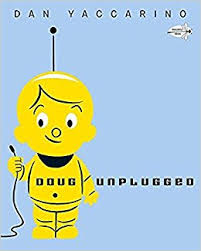
Doug Unplugged

Doug Unplugged By Dan Yaccarino

Yaccarino Dan. Doug Unplugged. New York: Knopf Books for Young Readers, 2013.


Lexile Level: 630
Grades: 3-5
Summary: This is a story about Doug, who is a robot. The problem is his parents want him to be smart, so each morning they plug him in and automatically start the information flowing and downloading. After Doug spends a morning learning facts about the city, he decides he wants to learn even more by going outside and exploring it on his own. He ends up getting into a day of adventure and discovery. Doug learns amazing things when he is unplugged and above all, being able to interact and make a new friend.
Selling Tool: Infographic
Learning activity: ELA- Writing Opinion Pieces using Text Evidence
Students will read Doug Unplugged and discuss question after reading, Do you think kids spend too much time on computers?
Students will then choose a side to develop a thesis to start researching for writing an opinion piece based on evidence from the text.  Students will be using the website, Wonderopolis to search for articles to get their textual evidence.


They will write down their claim, and give three details (reasons) from the text to support their claim, and they will expand in their own words what the details mean to them. Students will fill out a graphic organizer first with their research, then write or speak their Opinion writing through the use of an online Voki. The Voki will also be used as a tool for students to edit/revise their work


Learning Goal: Students will be able to write an opinion piece using three pieces of evidence from the text to support their claims. They will then present their opinion pieces through the technology tool, Voki.


Learning Objectives:
  • Students will identify a claim along with three pieces of text evidence to support their claim of “Too much time spent on computers a bad thing.” OR “Spending time on the computer has positive benefits for kids.”  on their Opinion Graphic Organizers(Cognitive).


  • Students will present their opinion writing by being able to speak or write to create  an online avatar called, Voki (Cognitive and Psychomotor).


Learning Standards:
CC Standards:Text Types and Purposes:
Write opinion pieces on topics or texts, supporting a point of view with reasons.
Introduce the topic or text they are writing about, state an opinion, and create an organizational structure that lists reasons.


Information Fluency Continuum:
5.3 Selects and uses multiple appropriate print, nonprint, electronic, and human sources to answer questions.
5.6 Uses various note taking strategies (e.g., outlining, underlining, bulleted lists, highlighting, graphic organizers)


American Association School Library:
4 Find, evaluate, and select appropriate sources to answer questions.
2.4.1 Determine how to act on information (accept, reject, modify).