Wednesday, November 15, 2017

I Survived: The American Revolution, 1776

I Survived: The American Revolution, 1776

Tarshis, Lauren.  I Survived: The American Revolution, 1776. New York: Scholastic Press, 2017.
Lexile: 660    Recommended for: Grades 3-5
 Selling Tool: Infographic
Summary: This is a historical fiction novel about an 11-year-old  boy named Nathaniel Fox who never would've believed his life was real to find himself in the middle of a blood-soaked battlefield- fighting for his life. He was being  worked to the bo ne by his cruel uncle and finally had enough so decided to flee from home. He finds himself right in the middle of the Revolutionary War. He ends up in New York City only to be involved in one of the biggest battles of history.
Activity: Fact Checking The American Revolution:  Did the author portray history accurately?
Students in a 5th grade class will use this book to compare details from the book to factual information of what really happened in the Revolutionary War. They will read and identify examples and details from the text, and use digital resources to fact check their answers. Then they will draw conclusions on whether or not the author was accurate on the portrayal of history and use details to support their claims.
Lesson Outcome: Students will read this historical fiction novel and use details from the text and fact checking through research to conclude whether or not the author was accurate in portraying history.  
Objectives/Assessments:
Students will identify three details from the story about the Revolutionary War of 1776, and research in order to fact check to determine of the author was accurate in portraying events. (Cognitive)
Students will draw conclusions from their research on whether or not this book is an accurate portrayal of the real Revolutionary War of 1776. They will present their findings and debate their claims with peers. (Psychomotor, Affective)
Assessment:
Teacher observation of student discussion debates
Standards:
Information Literacy Continuum:
5.6 Uses various note taking strategies (e.g., outlining, underlining, bulleted lists, highlighting, graphic organizers).
5.3 Selects and uses multiple appropriate print, nonprint, electronic, and human sources to answer questions.
Common Core Standards:

Key Ideas and Details:CCSS.ELA-LITERACY.RL.5.1

Quote accurately from a text when explaining what the text says explicitly and when drawing inferences from the text.
AASL Standards:
1.1.7 Make sense of information gathered from diverse sources by identifying misconceptions, main and supporting ideas, conflicting information, and point of view or bias.

Work Cited: 
Scholastic.com. Analyzing the Authors Use of Historical Facts- Graphic Organizer. Retrieved on November 1st, 2017 from https://www.scholastic.com/content/dam/teachers/lesson-plans/migrated-featured-files/i-survived-historical-facts.pdf 

George

“George” by  Alex Gino

Gino, Alex.  George.  New York: Scholastic Press, 2015.
Age Range: 8–12
Lexile: 790
Summary: This is the story of Melissa, whose friends and family know her as George. This is a novel about a transgender boy who identifies as a female.   George thinks she'll have to keep this a secret forever. Then her teacher announces that their class play is going to be Charlotte's Web. George really, really, REALLY wants to play Charlotte. But the teacher says she can't even try out for the part  because she's a boy. With the help of her best friend, Kelly, George devises a plan so everyone can know the real her once and for all.
Book Selling Tool: Infographic
Activity:   Being an Ally:
Students will first be asked to think, What is an ally? and,What are some examples of ally behavior you have seen in school? What are examples of ally behavior in the book?
Students will then, brainstorm characters in the book who displayed “ally” behavior. These could include George’s best friend Kelly, George’s brother Scott, Principal Maldonado. Students will each get an Ally worksheet
Students will go through the book and jot down as many instances of ally behavior that that they can quotes, actions, etc.  and apply them to create real world examples. As a culmination, students will work in groups to express their knowledge on Ally’s with illustrate their examples of ally behavior by creating a final project which could an Imovie or
Groups will respond to each others presentations through a peer feedback rubric in which they agree or disagree with each group's definition, example from book, and real world connections and explain why or why not.

Standards:

Key Ideas and Details:

Cite textual evidence to support analysis of what the text says explicitly as well as inferences drawn from the text.
.
AASL:
2.1.3 Use strategies to draw conclusions from information and apply knowledge to curricular areas, real world situations, and further investigations.
2.1.5 Collaborate with others to exchange ideas, develop new understandings, make decisions, and solve problems.
Information Literacy:
6.4 Presents conclusions and supporting facts in a variety of ways.  

Learning Outcomes: Students will use evidence from the text (quotes or examples) to make real world connections of what an ally is and how a person can be one. They will then create IMovies or  an Animaker  to connect all of their ideas for what makes an Ally (using support from the book plus their own real world scenarios).
Learning Objectives
Students will identify 4 quotes/examples from the text and analyze how those examples contribute to real world applications of being an ally (Cognitive).

Students will create an Imovie or an Animaker  and assess each of their peers presentations for feedback and clarification on own definition of what being an ally means (Psychomotor, Affective).

Assessments
Student created  Imovie
Student Peer Feedback Rubric


Work Cited:
Anti-Defamation League. ADL's Book of the Month: George. 2016. Retrieved on November 6th from https://www.adl.org/sites/default/files/documents/assets/pdf/education-outreach/book-of-the-month-george.pdf 

This One Summer

“This One Summer”by Mariko Tamaki

Tamaki, Mariko. This One Summer. New York: First Second, 2014.
Lexile: 300
Fountas and Pinnell: Level Z
Recommended for: Grades 5-7
Selling Tool: Book Review
Summary: This is a graphic novel about  a girl named Rose goes with her parents to their lakehouse in Awago Beach. She has a friend named Windy who is like a little sister to her.  This is a different summer though. Rose's mom and dad won't stop fighting, and when Rose and Windy try to escape the drama they come into a whole new set of problems they have to deal with. This book can be considered controversial because it deals with some hot topics like: teen pregnancy, peer pressure, and depression among other things.
Activity: This book would be great to use in the classroom for an ELA lesson on teaching Persuasive Writing and “Controversy in Literature”. Students will be able to read this book (among others) and apply examples from the book that could be considered controversial or too sensitive. They will chose a side either FOR or AGAINST having this book in our school library. They will then find instances in the book that pertain to topics of concern, and support their reasons with evidence. Students will then be able to debate their claims and evidence with the rest of the class as part of a Mock Trial Debate on identifying quality literature for students. I would use this book as a teachable moment to have m students decide as a class if this book should or shouldn't be allowed in schools and the support to backup their claims.  Students will fill out their graphic organizers and then write a persuasive essay in which will be presented during the debate portion of the activity. We will vote as a class on if this book should stay on the shelves or be put to the side because it is “too controversial”.
Students will be able to respond to their peers through questioning and comments. The teacher will be assessing this through the use of a checklist for each student presentation and comments that are made on their overall understanding.
Learning Outcome: Students will read This One Summer and identify controversial issues throughout. They will then choose a side and state a claim whether they think this literature should stay in the school library or be banned, with three reasons and examples to support their claims.
Learning Objectives:
  • Students will state a claim, identify and explain three reasons of controversial topics discussed in “This One Summer”. (Cognitive) Here is the graphic organizer they will be using.
  • Students will debate their findings with other peers to determine if this literature should be kept on school library shelves (Psychomotor, Affective) Students will be assessed through a teacher checklist of observation.
Standards:
NYS Common Core:

Key Ideas and Details:

Quote accurately from a text when explaining what the text says explicitly and when drawing inferences from the text.
AASL:
2.3.1 Connect understanding to the real world.
4.3.1 Participate in the social exchange of ideas, both electronically and in person.
Information Literacy Continuum:
5.7 Forms opinion and uses evidence from text to back it up.


Work Cited: 

Comic Book Legal Defense Fund. Using Graphic Novels in Education: The One Summer. 2007, Retrieved on October 5th, from http://cbldf.org/2015/02/using-graphic-novels-in-education-this-one-summer/

“The Absolutely True Diary of a Part-Time Indian”

“The Absolutely True Diary of a Part-Time Indian” by  Sherman Alexie


Alexie, Sherman.  The Absolutely True Diary of a Part-Time Indian.  New York: Little Brown and Company, 2007.

Lexile: 600

Summary: This is a story about a boy name Junior who grows up on an Indian Reservation. He likes to draw cartoons and has to attend an all-white farm town high school where the only other Indian is the school mascot. This book is about his experiences living on an Indian Reservation and what life is like living as both an American and an Indian. Transferring schools stirs up racial tensions on the reservation, and though the reservation is considered like a prison to him, he quickly learns that the grass isn't always greener on the other side.
Book Selling Tool: Book Trailer
Activity:  ELA skill of Analyzing/Evaluating Text for character development when teaching about “Assimilation”. Have students identify through the use of a log how Junior is constantly dealing with the differences between the existence of white people vs. the Indians on his reservation. These differences are mentioned both in the text and in the cartoons. Students will identify 4 examples and how it affected Junior. They will then write a brief summary of their conclusions as to how Junior changed as a character from the beginning to the end.
Student will use this for their note taking
They will be able to discuss and respond to peers with their conclusions through the use of an online blog where they will have meaningful discussions on the results and evidence they concluded on the character development of Junior from the beginning of the book to the end, and how he changed as a person based on his experiences.  Students will post their discussion on KidBlogs, then interact with their peers by leaving them feedback. Here is an example of what a Kid Blog looks like.
Standards:
Common Core: Craft and Structure:
CCSS.ELA-LITERACY.RL.6.5Analyze how a particular sentence, chapter, scene, or stanza fits into the overall structure of a text and contributes to the development of the theme, setting, or plot.
AASL:
2.1.5 Collaborate with others to exchange ideas, develop new understandings, make decisions, and solve problems.
2.2.3 Employ a critical stance in drawing conclusions by demonstrating that the pattern of evidence leads to a decision or conclusion.
Information Literacy:
6.3 Combines information and weighs evidence to draw conclusions and create meaning
Learning Outcomes: Students will draw conclusions using evidence from the text to show how Junior changed/evolved as a character through the experiences he went through in the book.
Learning Objectives:
Students will identify 4 quotes/graphic from the text and analyze how those experiences affected Junior and contributed to his character development. (Cognitive)
Students will draw their own conclusions of how Junior changed from beginning to end based on the evidence they analyzed from the text. (Congive)

Students will create a blog and respond to at least 2 other of their peers’ blog’s on their own summations of character development and to provide feedback. (Psychomotor, Affective)


Assessments:
Student note taking sheet
Student created Kid Blog


Work Cited:
Scholastic. The Absolutely True Dairy of a Part-Time Indian Teaching Guide. Retrieved on November 5, 2-17 from https://www.scholastic.com/teachers/lesson-plans/teaching-content/absolutely-true-diary-part-time-indian-storia-teaching-guide/


Wonder

“Wonder” by R.J. Palacio

Palacio, R.J..  Wonder. New York: Knopf, 2012.
Lexile: 790
Summary: This is a story about a ten year old named Auggie (August) who lives in NYC and goes to school for the first time since he’s been homeschooled his whole life. He has a facial deformity that prevented him from going to school. His deformity makes it difficult for him to make friends and his story is one that makes readers think, do onto others as you would want done to yourself.
Book Selling Tool: Infographic
Activity: I would use this text with an ELA 5th grade classes.
Students will read this book and identify two reoccurring themes. They will provide text evidence to support their claims. They will then create a storyboard with dialogue from the text to depict each theme as represented in the text. Then students will connect their chosen theme to real life, either imagined or historical, and produce their responses in the form of an online storyboard. (They need one theme to go along with ONE real life example of choice- this gives them application of the theme and real world examples through student choice of response) Some examples of themes would be:
  
  • Courage
  • Believe in yourself.
  • You are stronger than you think.
  • Family is important.
  • Don’t judge a book by its cover
Standards:
Common Core: Key Idea and Details
Determine a theme of a story, drama, or poem from details in the text, including how characters in a story or drama respond to challenges or how the speaker in a poem reflects upon a topic; summarize the text.
AASL:
2.1.4 Use technology and other information tools to analyze and organize information.
4.1.2 Read widely and fluently to make connections with self, the world, and previous reading. 4.1.3 Respond to literature
Information Literacy:
5.6 Uses various note taking strategies (e.g., outlining, underlining, bulleted lists, highlighting, graphic organizers).

Learning Outcomes: Students will determine themes read throughout the story and be able to use evidence/moments from the story to support their themes. They will also apply real world context be providing a historical/personal example of that theme to create a Storyboard.
Learning Objectives
Students will identify 2 or more themes presented in the story, Wonder, and give evidence to support their answers. (Cognitive)

Students will create a Storyboard that includes a theme that has : dialogue from the story (one more more examples from the book) and one other historical/real world example to go along with the theme.  (Psychomotor, Cognitive)
Assessments
Student Graphic Organizers with 2 or more themes identified.
Student created Storyboards


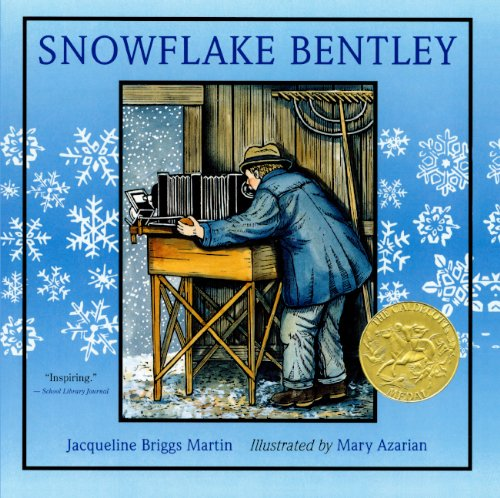
Snowflake Bentley

 Snowflake Bentley by Jacqueline Briggs Martin


Martin ,Briggs Jacqueline. Snowflake Bentley. New York: Houghton Mifflin , 2009.
Lexile Level: 830
Fountas and Pinnell: Level P
Grades: 5-7
Summary: This is a biography based on the life of Wilson Bentley who saw snowflakes as tiny miracles. He was determined to capture images of each unique crystal and show them to the world with his microscope camera. He was a very misunderstood person but with perseverance he was able to give children everywhere a close up look at marvelous snowflakes and the true essence and beauty of each individual one falling from the sky.
Selling Tool: Infographic
Learning activity for the book:
Students will read this book and create their own 3D snowflakes.  
Math concepts in this activity:
  • Symmtry
  • Geometry
Students will read Snowflake Bentley and be able to observe all the different kinds of unique snowflakes that were captured through Bentley’s camera microscope. Students will then be asked questions like,  How do snowflakes form? •Why are no two snowflakes alike? What are some unique properties of snow?

They will then choose one of the three examples of snowflakes in this Slideshow or create one of their own. Students will show symmetry by using knowledge of measurement and geometry of different angles learned about. They will take their designs to create a real 3D image using Tinkercad and printing them on the 3D printer.

Students will then reflect on their learning by completing a Strengths and Needs Self Assessment to see what concepts they still struggle with and need help with in the future and to also focus on their strengths of what they can do.

Learning Goal: Students will be able to create a symmetric 3D snowflake on the 3D printer after reading the biography, Snowflake Bentley.

Objectives:
Students will be able to create symmetric snowflakes based by measuring geometric shapes (Cognitive).


Students will reflect on their own learning about symmetry and creation of a 3D snowflake (Psychomotor, Affective).

Assessments:
Student completed Tinkercad snowflakes
3D Snowflake

Objective 2: Student completed Strengths and Needs Worksheet

Learning Standards:
CC Standards: Reading Literature:
Represent real world and mathematical problems by graphing points in the first quadrant of the coordinate plane, and interpret coordinate values of points in the context of the situation.

Information Fluency Continuum:
5.11 Identifies own strengths and sets goals for improvement.

American Association School Library:
3.1.4 Use technology and other information tools to organize and display knowledge and understanding in ways that others can view, use, and assess.
2.1.4 Use technology and other information tools to analyze and organize information.

Work Cited: