Wednesday, November 15, 2017

Mamma Llama Mad At Mama

Mamma Llama Mad At Mama by Anna Dewdney Image result for llama llama mad at mama


Dewdney, Anna. Mamma Llama Mad At Mama.  Penguin Young Readers Group. New York:  2007.
Lexile Level:370 Guided Reading Level L
Grades: K-3 (1st grade lesson activity)


Summary:  This is a story about Llama Llama going on shopping trip with his mother and he is not happy.  They go to the Shop-O-Rama where there is yucky music and great big feet, and ladies smelling way too sweet. He is forced to try on itchy clothing and wait while Mama deliberates over food items. Llamma gets so upset he lashes out in tantrums only to have his mother help him realize that shopping can really be a fun thing!
Selling Tool: READ ALOUD
Learning activity for the book:
Students will read this book and make text-to-self connections of details in the story to real life examples ow how they cope with their own problems. We will discuss different emotions we may experience in life like boredom, anger and disappointment. Students will choose one detail from the story  to draw, then write a sentence of how they would feel if they were in that same situation. We would discuss their answers and talk about different ways to cope with those same problems.


Learning Goal: Students will be able to identify a detail from the story to make a sentence applying a text to self connection.
Objectives
Assessments
Students will be able to identify a detail from the story and write one sentence of how they would feel to make a text-to-self connection.Cognitive).
Students will discuss their detail and text to self connections as a whole class. Then they will give one example of how they would cope with that situation (Psychomotor, Affective)
Teacher observation of student discussion


Learning Standards:
Common Core Standards:
CCSS.ELA-LITERACY.RL.1.3
Describe characters, settings, and major events in a story, using key details.


Information Fluency Continuum:
1.1 Share what is known about the general topic to elicit and make connections to prior knowledge.


American Association School Library:
4.1.5 Connect ideas to own interests and previous knowledge and experience.
3.1.3 Use writing and speaking skills to communicate new understandings effectively.

Work Cited: 
Moritz Fine Designs. Llama Llama Has Feelings. 2012. Retrieved on September 30,2017 from from http://www.thecurriculumcorner.com/thekindercorner/wp-content/pdf/authorstudy/llama/llamafeelings.pdf 


I Have To Go

“I Have to Go”by Robert Munsch

Munsch, Robert . I Have To Go. New York: Annick Press, 1987.
Lexile: 500  Recommended for: Grades k-3

Selling Tool: Storytelling Final One
Summary: This is a story about a child named Andrew who is going through toilet training. He never wants to go pee when his parents asks him but always has to go minutes later after they leave the house or after they take 30 minutes to bundle him up in his snowsuit, or after he is in bed every single night. With tons of repetition and repetitive language this book will add humor to any classroom or elementary library.


Can be used in Library Curriculum: This book would be great to use in the classroom for a First Grade ELA lesson on teaching Problem and Solution. Students will read this book and determine the major problem and solution based on details/examples from the text. They will then apply a real world problem in their own life they may have experienced, and describe how they were able to solve that problem. Students will be making text-to-self connections through this activity. They will complete a graphic organizer and then share and discuss their own real world examples with other peers.

Extension: Students will use the IPADS to create a class video of their created  real life problems and solutions to be apart of a “Work Hard, Get Smart” Growth Mindset video on Perseverance.
Learning Outcome: Students will read I Have to Go, and identify the story’s main problem and solution with examples from the story. Students will then respond with their own problem and solution scenario to apply real world context to the ELA strategy.
Objectives
Students will identify the main problem and solution of the story “I Have to Go” by Robert Munsch. (Cognitive).
Students will connect what they read in the text to create a real world problem and solution. They will discuss their own experiences with other peers (Cognitive, Psychomotor).


Assessments:
Turn and Talks- Teacher Observation


Standards:
NYS Common Core:

Integration of Knowledge and Ideas:CCSS.ELA-LITERACY.RL.1.7

Use illustrations and details in a story to describe its characters, setting, or events.
AASL:
2.3.1 Connect understanding to the real world.
4.3.1 Participate in the social exchange of ideas, both electronically and in person.
Information Literacy Continuum:
1.1 Share what is known about the general topic to elicit and make connections to prior knowledge.

Work Cited:
Problem and Solution Printable. Teachers Pay Teachers. Retrieved on November 19, 2017 from https://www.teacherspayteachers.com/Product/ProblemSolution-Writing-printable-215651 


I Too, Am America

“I Too, Am America” by Langston HughesImage result for i too am america

Hughes, Langston.  I Too, Am America. New York: SImon and Schuster Books, 1994.
Lexile:  500 Grades: 5-7
Summary: This is a poetry book for older students that
Book Selling Tool: Book Trailer
Activity: I would use this text with a 6th the grade classes. One way I could make this text come alive is through integrating social studies with the topic of Civil Rights and relevance of the theme today. I will ask students to imagine going into a time capsule to speak to Langston Hughes. What would they want to say to either poet with their poems? I remind them that history can always be a source of inspiration, and in poetry, there are no boundaries preventing us from speaking with anyone from the past. 
Students will write a poem to Langston Hughes about how history has changed since he wrote this poem in 1994 . They will use examples of what happened in the poem to apply it to what's happening in America today. Students will share their poems and peer assess each other on specific criteria using a rubric for feedback.


Criteria on Rubric: Here is the Rubric
Standards:
Common Core: Key Idea and Details
• CCSS.ELA-LITERACY.RH.6-8.4 Determine the meaning of words and phrases as they are used in a text, including vocabulary specific to domains related to history/social studies.
• CCSS.ELA-LITERACY.RH.6-8.6 Identify aspects of a text that reveal an author's point of view or purpose (e.g., loaded language, inclusion or avoidance of particular facts)
AASL:
4.1.2 Read widely and fluently to make connections with self, the world, and previous reading.
4.1.3 Respond to literature
Information Literacy:
6.4 Presents conclusions and supporting facts in a variety of ways.


Learning Outcomes: Students will create a poem intended for Langston Hughes on how history has changed since 1994. They will use poetic criteria such as line line breaks and voice to contribute to overall meaning. They will also analyze historical events in the book to to make connections to real world.
Learning Objectives
Students will read I Too, Am America and analyze what injustices happened in the book and apply it to what is going on in  America today (Cognitive).

Students will present and peer assess  each other's poems based on 7 criteria (Psychomotor, Cognitive).

Assessments
Student created poems
Peer Assessment Rubrics

Work Cited:
Teachers and Writers Magazine. Lesson Plan. Retreieved on October 8th, 2017 from https://teachersandwritersmagazine.org/wp-content/uploads/2016/03/Dean-Kostos-Conversation-Poems-LP-1.pdf 

The Notorious Benedict Arnold

“The Notorious Benedict Arnold”by Steve Sheinkin

Sheinkin, Steve. The Notorious Benedict Arnold. New York : Flashpoint/Roaring Book Press, 2010.
Lexile: 990
  Recommended for: Grades 5-7
 Selling Tool: Book Talk
Summary: This is a first person account of Benedict Arnold’s life- the real story. Most people know that he was America's first traitor. However few know that he was also one of its greatest Revolutionary War heroes. This biography brings to life the real Arnold: reckless yet heroic, and super driven.  This book is jammed packed with action and battle scenes, twists and turns, and, this is a gripping and true accounts of Arnold’s life that may night be told in history books.
Activity:  This book would be great to use in the classroom as an ELA/Social Studies unit on:  teaching and conducting research on the Revolutionary War. One way I would integrate this book is by doing a  Compare/Contrast of this book to other written work on Benedict Arnold’s life. You could collect samples of American history textbooks that discuss the American Revolution and have students compare and contrast in small groups the individuals who are cited in the textbooks for specific actions they took. Students would respond to the question: Do you think Arnold was a traitor as he is portrayed or a hero? Why or why not.

They will then draw conclusions based on the research from details in the story and other research using print and text. Students will then create a Powtoon to Americans letting them know of his “real truths”.
Lesson Outcome: Students will read “The Notorious Benedict Arnold” and compare what they read to other text (history books) to determine if he was really a villain or a hero based on the research.
Lesson Objectives/Assessments:
Objective:
Assessment:
Students will generate a list of questions to research on Benedict Arnold’s life. They will use this book and other history books to answer 4 or more student generated questions. (Cognitive)
Students will draw conclusions and choose a side whether or not Benedict Arnold was a hero or a villain based on research  and create a Powtoon to Americans about his “real truths” using the research from their notes.
Student created Powtoon videos
Standards:
Information Literacy Continuum:
6.3 Combines information and weighs evidence to draw conclusions and create meaning.  
Common Core Standards:
CCSS.ELA-LITERACY.RL.6.9 Compare and contrast texts in different forms or genres (e.g., stories and poems; historical novels and fantasy stories) in terms of their approaches to similar themes and topics.
AASL Standards:
1.1.5 Evaluate information found in selected sources on the basis of accuracy, validity, appropriateness for needs, importance, and social and cultural context.
1.1.7 Make sense of information gathered from diverse sources by identifying misconceptions, main and supporting ideas, conflicting information, and point of view or bias.
Work Cited:


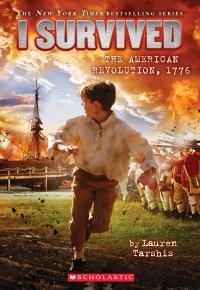
I Survived: The American Revolution, 1776

I Survived: The American Revolution, 1776

Tarshis, Lauren.  I Survived: The American Revolution, 1776. New York: Scholastic Press, 2017.
Lexile: 660    Recommended for: Grades 3-5
 Selling Tool: Infographic
Summary: This is a historical fiction novel about an 11-year-old  boy named Nathaniel Fox who never would've believed his life was real to find himself in the middle of a blood-soaked battlefield- fighting for his life. He was being  worked to the bo ne by his cruel uncle and finally had enough so decided to flee from home. He finds himself right in the middle of the Revolutionary War. He ends up in New York City only to be involved in one of the biggest battles of history.
Activity: Fact Checking The American Revolution:  Did the author portray history accurately?
Students in a 5th grade class will use this book to compare details from the book to factual information of what really happened in the Revolutionary War. They will read and identify examples and details from the text, and use digital resources to fact check their answers. Then they will draw conclusions on whether or not the author was accurate on the portrayal of history and use details to support their claims.
Lesson Outcome: Students will read this historical fiction novel and use details from the text and fact checking through research to conclude whether or not the author was accurate in portraying history.  
Objectives/Assessments:
Students will identify three details from the story about the Revolutionary War of 1776, and research in order to fact check to determine of the author was accurate in portraying events. (Cognitive)
Students will draw conclusions from their research on whether or not this book is an accurate portrayal of the real Revolutionary War of 1776. They will present their findings and debate their claims with peers. (Psychomotor, Affective)
Assessment:
Teacher observation of student discussion debates
Standards:
Information Literacy Continuum:
5.6 Uses various note taking strategies (e.g., outlining, underlining, bulleted lists, highlighting, graphic organizers).
5.3 Selects and uses multiple appropriate print, nonprint, electronic, and human sources to answer questions.
Common Core Standards:

Key Ideas and Details:CCSS.ELA-LITERACY.RL.5.1

Quote accurately from a text when explaining what the text says explicitly and when drawing inferences from the text.
AASL Standards:
1.1.7 Make sense of information gathered from diverse sources by identifying misconceptions, main and supporting ideas, conflicting information, and point of view or bias.

Work Cited: 
Scholastic.com. Analyzing the Authors Use of Historical Facts- Graphic Organizer. Retrieved on November 1st, 2017 from https://www.scholastic.com/content/dam/teachers/lesson-plans/migrated-featured-files/i-survived-historical-facts.pdf